Best Free AI Detector for Teachers 2026 — No Signup
Free AI detector for teachers — check student essays for ChatGPT & Claude. Understand false positive risks for ESL students. No account needed, instant results.
Zoe Parker
Founder & Lead AI Research Scientist, QuillBotAI Pro
NLP Specialization
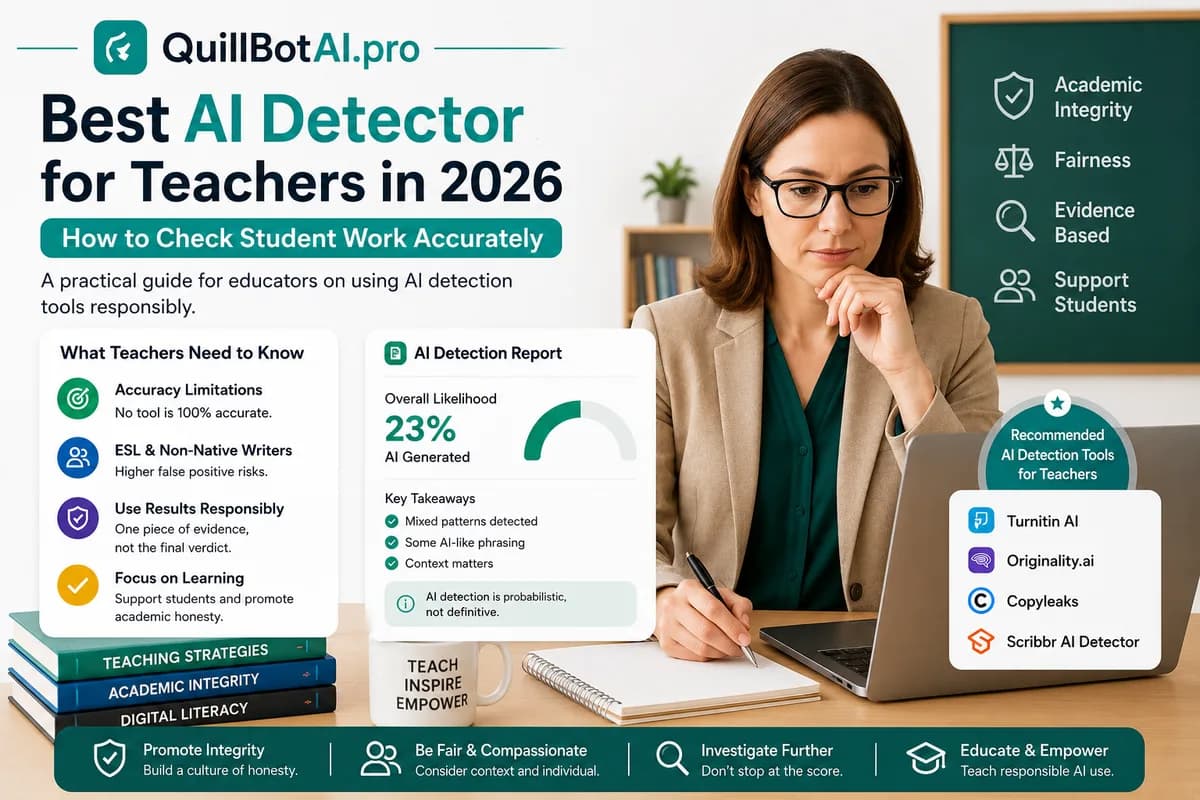
AI detection for educators is genuinely complicated in 2026. The tools have improved. But the limitations — particularly around false positives on ESL writing — haven't disappeared, and the consequences of a wrongful academic integrity accusation are serious.
This guide is written for teachers who want to use AI detection responsibly: with accuracy data, not marketing claims.
What You Actually Need to Know Before Using an AI Detector on Student Work
1. No AI Detector Is Conclusive Evidence
Every credible AI researcher and detector developer acknowledges this: AI detection produces probabilistic estimates, not verdicts. A 78% AI score means the statistical patterns in this text put the estimated probability of AI involvement at 78% — not that 78% of the text is AI-written, and not proof of any specific student action.
Use AI detection output the way you'd use a plagiarism similarity score: a signal that prompts further investigation, not standalone grounds for a penalty.
2. ESL Students Are Disproportionately Flagged
If you teach where students write in English as a second, third, or fourth language — which covers most international universities and a growing share of domestic institutions — understand this:
Formal ESL academic writing shows low perplexity and low burstiness. Those are the same statistical patterns detectors use to identify AI writing. Students who learned formal English in structured, discipline-heavy educational systems get flagged by most detectors at dramatically elevated rates.
The peer-reviewed evidence is stark: Stanford researchers (Liang et al., 2023, Patterns) ran 91 genuine human TOEFL essays through seven popular GPT detectors, which misclassified an average of 61% of them as AI-generated — while performing near-perfectly on native-speaker essays.
If your class has ESL students and you're using ZeroGPT or a similar tool, expect to wrongly flag one in three to one in two non-native English writers. For the full research breakdown, see our deep-dive on AI detector false positives and ESL writers.
3. Detection Accuracy Degrades After Model Updates
After each major AI model release (GPT-5, Claude 4, Gemini 2, etc.), detectors lose calibration for 60–90 days while they update their fingerprinting. During that window, content from the newest model version is partially invisible to detection tools.
That creates a specific window of risk: students using very recently released AI models may be harder to catch than those using established ones.
Recommended Tool: The Academic Integrity Detector
For educators without institutional Turnitin access, QuillBotAI Pro is the most accurate free option that works without an account.
What it provides:
- Sentence-level output with a confidence level per line, so you see which sentences raised the flag — not just one score
- Explicit calibration for non-native English writing, built around the documented ESL false-positive problem
- A sentence-level heatmap showing exactly which segments are flagged
- Detection of ChatGPT-4o, GPT-5, Claude 3.5, Gemini 1.5, Llama 3, Mistral
- No signup, no word limits, completely free
What it doesn't provide:
- Plagiarism detection (use a separate tool for this)
- Institutional reporting (results carry weight as investigative input, not official evidence)
- API for automated batch checking (manual paste only)
A Responsible Academic Integrity Workflow
Here's how to use AI detection in a way that protects both academic standards and student rights.
Step 1: Establish Your Baseline
Before scanning student submissions, run the tool on your own writing and on samples you know are human-authored. Get a feel for what "natural" scores look like for your discipline and student population.
Academic writing in technical fields (science, engineering, medicine) tends to produce higher AI scores than creative writing or personal essays, because technical writing is inherently formal and low-burstiness. Your baseline for a chemistry lab report should look nothing like your baseline for a reflective essay.
Step 2: Scan Submissions Holistically
Don't scan one suspicious submission in isolation — scan everything, or a representative sample. That gives you comparative data: a student whose essay scores 55% when the class average sits at 15–20% is far more noteworthy than a 55% score seen alone.
Step 3: Focus on the Sentence-Level Heatmap, Not the Score
The overall percentage score is the least useful output here. The sentence-level heatmap tells you where the AI patterns actually are. An essay that's uniformly yellow (moderate confidence) throughout is consistent with formal ESL writing or heavy source summarization. Three paragraphs solid red against an otherwise green essay is a different, more concerning pattern — consistent with AI insertion into human writing.
Step 4: Investigate Before Acting
A high AI detection score should trigger a conversation, not a penalty. Call the student in, ask them to explain their writing process, and have them summarize the argument in the flagged sections. Ask what sources they used. Ask them to write a short paragraph in the same register on a related topic, in front of you.
A student who used AI and doesn't understand the content will struggle with that. A student flagged for writing in formal ESL won't have any trouble explaining the material.
Step 5: Document Everything
If you move to a formal academic integrity review, document which tool you used, what score it produced, which specific sections were flagged, and what follow-up investigation you conducted. Your institution's academic integrity process needs that chain of evidence to hold up.
AI Detector Comparison for Educators
| Tool | Sentence-Level Output | ESL Calibration Documented | Signup | Cost |
|---|---|---|---|---|
| QuillBotAI Pro | Yes, with per-line confidence | Yes (incl. Urdu, Roman Urdu, Hindi) | No | Free |
| Scribbr | No | No | No | Free |
| GPTZero | Paid tiers | No | Yes (free) | Free/paid |
| Turnitin | Highlighted segments | Disputed* | Institutional only | License fee |
| ZeroGPT | Highlights only | No | No | Free |
*Turnitin publishes a low false-positive claim, but institutions including Vanderbilt have disabled its AI detector over false-accusation risk. We deliberately don't publish accuracy percentages here — vendor-run benchmarks, ours included, aren't a sound basis for disciplinary decisions.
The Ethical Dimension
In 2026, the professional consensus among assessment researchers is that AI detection tools shouldn't be the primary or sole basis for academic integrity decisions. Multiple academic associations — including the Modern Language Association and several UK research councils — recommend treating AI detection output as investigative input, not evidence.
That's not because AI cheating doesn't happen. It does, and it's a genuine assessment integrity challenge. It's because false-positive rates run high enough that acting solely on detector output causes provable harm to innocent students, because the burden of proof shouldn't be reversed onto a student to disprove a statistical estimate, and because tool accuracy degrades over time and varies by writing context in ways most educators aren't tracking when they deploy these systems.
Use the tools. They're useful signals. Just don't use them as verdicts.
FAQ
What is the most accurate free AI detector for teachers in 2026? QuillBotAI Pro is built specifically for the educator use case: per-sentence confidence output you can discuss with a student, explicit non-native English calibration, no account, and no word limits — practical for full-length essays. Like every detector, it should inform a conversation, never decide an outcome.
Can I use AI detection results to penalize a student? AI detection results alone aren't sufficient grounds for academic penalties at most institutions. Use them as investigative triggers that prompt further inquiry, not as standalone evidence. Always run a follow-up investigation — including a direct conversation with the student — before escalating.
Does AI detection work on non-native English student writing? Most tools produce high false-positive rates on ESL writing — Stanford research found popular detectors misclassified an average of 61% of genuine human TOEFL essays as AI. QuillBotAI Pro is explicitly calibrated for non-native English patterns, which reduces this risk but can't eliminate it. Some clean ESL submissions will still get flagged — understand that limitation before treating any result as evidence.
Which AI detector should teachers use without institutional Turnitin access? QuillBotAI Pro for AI detection, paired with a free plagiarism checker for plagiarism. If you want both in one tool, Copyleaks (requires signup, free tier available) combines plagiarism and AI detection. See our full guide to free Turnitin alternatives for a deeper comparison, and our guide for students if you want to point students to a pre-submission check.
How should I respond if a student disputes an AI detection result? Take the dispute seriously. Run the same text through at least one additional detector and compare results. Ask the student to walk you through their writing process and explain the content of the flagged sections. Consider whether ESL patterns could explain the elevated score. Involve your institution's academic integrity office before making a determination. Our guide on what a detector score can and can't establish covers the evidentiary limits in more detail.
Further reading: how AI detection actually works · what the peer-reviewed accuracy research found · the ESL false-positive problem
Topics
Written & Reviewed By Experts
Zoe Parker
AuthorFounder & Lead AI Research Scientist, QuillBotAI Pro
NLP Specialization · DeepLearning.AI via Coursera (2024–2025)
Zoe is the founder of QuillBotAI Pro and leads its detection research. Her work focuses on computational linguistics and identifying how large language models produce text.
Editorial policy: All QuillBotAI Pro articles are written by domain experts, independently peer-reviewed, and updated as new research emerges. We never accept sponsored content that influences editorial conclusions.