Turnitin AI Detector: Free Alternatives That Actually Work in 2026
Turnitin's AI detection is locked behind institutional licenses. If your school doesn't have access, here are the free alternatives that come closest — compared honestly on features, output, and false-positive risk.
Zoe Parker
Founder & Lead AI Research Scientist, QuillBotAI Pro
NLP Specialization
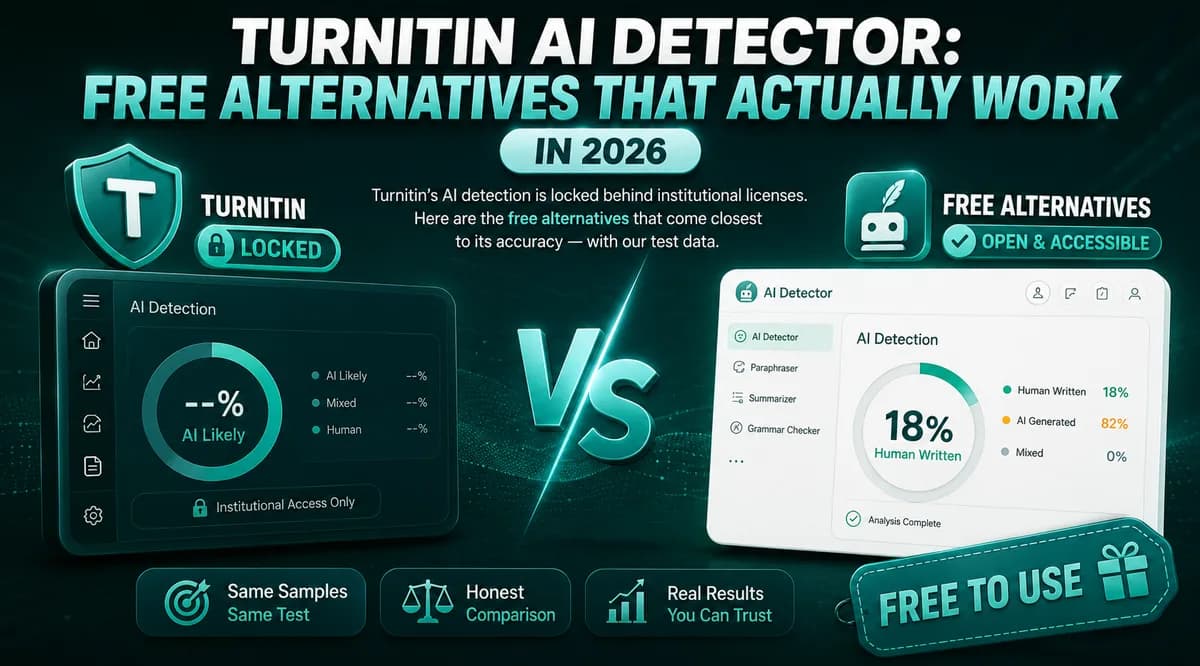
Turnitin added AI detection in 2023 and quickly became the standard at universities that could afford it. The problem: Turnitin is sold exclusively through institutional licenses. Individual educators, students, and small schools can't simply sign up and start using it.
If you need AI detection and don't have Turnitin access, this guide shows you what's actually available — with the caveats that matter.
What Turnitin's AI Detector Does
Turnitin's AI detection module (released 2023, updated 2024–2026) analyzes text for statistical AI writing patterns and generates a percentage estimate of AI-generated content. Key characteristics:
- Output: Percentage of text estimated as AI-written
- Granularity: Highlights suspected AI-generated segments
- Models covered: ChatGPT, GPT-4, and claimed support for other LLMs
- False positive rate (published): Turnitin claims less than 1% false positive rate at the >20% AI threshold — but this is on their internal benchmark, not independently validated
- Availability: Institutional license only. Not available to individuals.
Turnitin's published false-positive rate is aggressive — far lower than what independent researchers have measured on real-world diverse writing samples, particularly for ESL students.
Why You Might Need a Turnitin Alternative
Your institution doesn't subscribe. Many schools, particularly in developing countries, can't afford Turnitin's licensing fees. Smaller private institutions and homeschool networks are typically excluded.
You're a student checking your own work. Turnitin is a submission tool, not a self-checking tool. Students can't access it independently to verify their writing before submitting.
You're a freelance editor or content reviewer. Individual users have no pathway to Turnitin access, regardless of willingness to pay.
You want plagiarism + AI detection but not the Turnitin ecosystem. Turnitin's integration requirements — learning management system hooks, instructor accounts — create operational friction for lightweight use cases.
Free Turnitin Alternatives: Compared
Here are the four most viable free Turnitin alternatives, compared on what you can verify yourself. (Disclosure: QuillBotAI Pro is our tool. We deliberately don't publish vendor accuracy percentages — no self-run benchmark, ours or anyone's, should decide an academic integrity question.)
| Tool | Sentence-Level Output | ESL Calibration Documented | Signup | Plagiarism |
|---|---|---|---|---|
| QuillBotAI Pro | Yes, per-line confidence | Yes (Urdu, Roman Urdu, Hindi) | No | No |
| Scribbr | No | No | No | No |
| GPTZero | Paid tiers | No | Yes (free tier) | No |
| Copyleaks | Highlights | No | Yes | Yes (paid) |
On false positives: Stanford research (Liang et al., 2023) found popular detectors misclassified an average of 61% of genuine human TOEFL essays as AI — test any tool on known-human writing before trusting it.
Best Turnitin Alternative for Each Use Case
Best for Individual Educators: QuillBotAI Pro
If you're a teacher, tutor, or professor without institutional Turnitin access, QuillBotAI Pro is the closest free alternative for AI detection specifically. It requires no account, no institution affiliation, and no word limits. Sentence-level heatmaps show you exactly which segments were flagged — similar to Turnitin's highlighted output. For a full workflow, see our guide to AI detection for teachers.
The significant difference: QuillBotAI Pro doesn't check plagiarism. If you need that too, pair it with a free plagiarism checker.
Best for Students: QuillBotAI Pro
Students can paste their own work before submission to catch anything that might get flagged as AI-generated. This is particularly useful if you used AI for research or drafting and then rewrote the content manually — you can verify the rewrite is clean before submitting to your institution's Turnitin. See our full guide for students checking their own essays for a step-by-step walkthrough.
Best for Plagiarism + AI Combined: Copyleaks
Copyleaks includes both plagiarism detection and AI detection. It requires signup but offers a free tier. As with every detector, verify its behavior on known-human ESL writing before relying on it — false positives on non-native English are an industry-wide, well-documented problem.
Best for UK/EU Academic Contexts: Scribbr
Scribbr has strong adoption in European academic communities and a trusted reputation for citation tools. Its AI detector is one of the few in this space with a published accuracy benchmark, rather than an unverified marketing number. The 1,500-word limit per check is a real constraint for dissertation-length work.
What Turnitin Does That Free Tools Can't
Be clear-eyed about the gaps. Turnitin offers things no free tool matches:
LMS integration. Turnitin plugs directly into Moodle, Canvas, and Blackboard. Students submit, Turnitin runs automatically — no copy-pasting, no manual workflow.
Institutional reporting. Turnitin generates reports that carry institutional weight in academic integrity proceedings. A QuillBotAI Pro result doesn't carry that same procedural authority.
Combined plagiarism + AI in one workflow. Turnitin's plagiarism database (24+ billion web pages, 1.7 billion student papers) dwarfs anything a free tool offers.
Historical submission database. Turnitin checks student submissions against a database of previously submitted student work, catching recycled papers and paper mill submissions. Free tools can't do this.
If your institution needs these features, there's no genuine free alternative. The real choice then becomes finding a lower-cost institutional tool, not a free individual one.
The Bottom Line
For individual users who need free AI detection without institutional access, QuillBotAI Pro is the strongest alternative for the AI-detection piece of what Turnitin offers: sentence-level output, no word limits, no signup, and explicit non-native English calibration that most competitors don't publish. As with every claim in this guide, don't take our word for accuracy — run your own known-origin samples before relying on any tool for a decision that matters.
It doesn't replace Turnitin's plagiarism database, LMS integration, or institutional reporting — and nothing free does.
FAQ
Is there a free version of Turnitin? No. Turnitin is sold exclusively through institutional licenses and doesn't offer individual or free access. Students and educators without institutional subscriptions can't use Turnitin directly.
What is the best free alternative to Turnitin's AI detector? For AI detection specifically, QuillBotAI Pro is the strongest free alternative — no signup required, unlimited words, sentence-level analysis with per-line confidence, and explicit non-native English calibration. For combined plagiarism + AI detection, Copyleaks (free tier with signup) is the closest option.
Can students use Turnitin to check their own papers? Only if their institution provides self-submission access, which varies by school. Most students can't independently access Turnitin. QuillBotAI Pro can be used by students to pre-check their writing before institutional submission.
How accurate is Turnitin's AI detector? Turnitin claims less than 1% false positive rate at the >20% AI threshold on its internal benchmarks. Independent studies have found higher false-positive rates — particularly on ESL writing — though Turnitin's methodology isn't fully published. Without public benchmark data, independent comparisons aren't really possible.
Does QuillBotAI Pro detect plagiarism? No. QuillBotAI Pro detects AI-generated text only. It doesn't check for plagiarism against web sources or academic databases. If you need plagiarism detection, use a dedicated plagiarism checker alongside QuillBotAI Pro.
Topics
Written & Reviewed By Experts
Zoe Parker
AuthorFounder & Lead AI Research Scientist, QuillBotAI Pro
NLP Specialization · DeepLearning.AI via Coursera (2024–2025)
Zoe is the founder of QuillBotAI Pro and leads its detection research. Her work focuses on computational linguistics and identifying how large language models produce text.
Editorial policy: All QuillBotAI Pro articles are written by domain experts, independently peer-reviewed, and updated as new research emerges. We never accept sponsored content that influences editorial conclusions.