AI Detectors Are Wrongly Flagging ESL Students as Cheaters — The Research Is Damning
Stanford research found AI detectors misclassified 61% of real TOEFL essays as AI-generated. Here's why ESL writing triggers false positives, and what educators must do about it.
Zoe Parker
Founder & Lead AI Research Scientist, QuillBotAI Pro
NLP Specialization
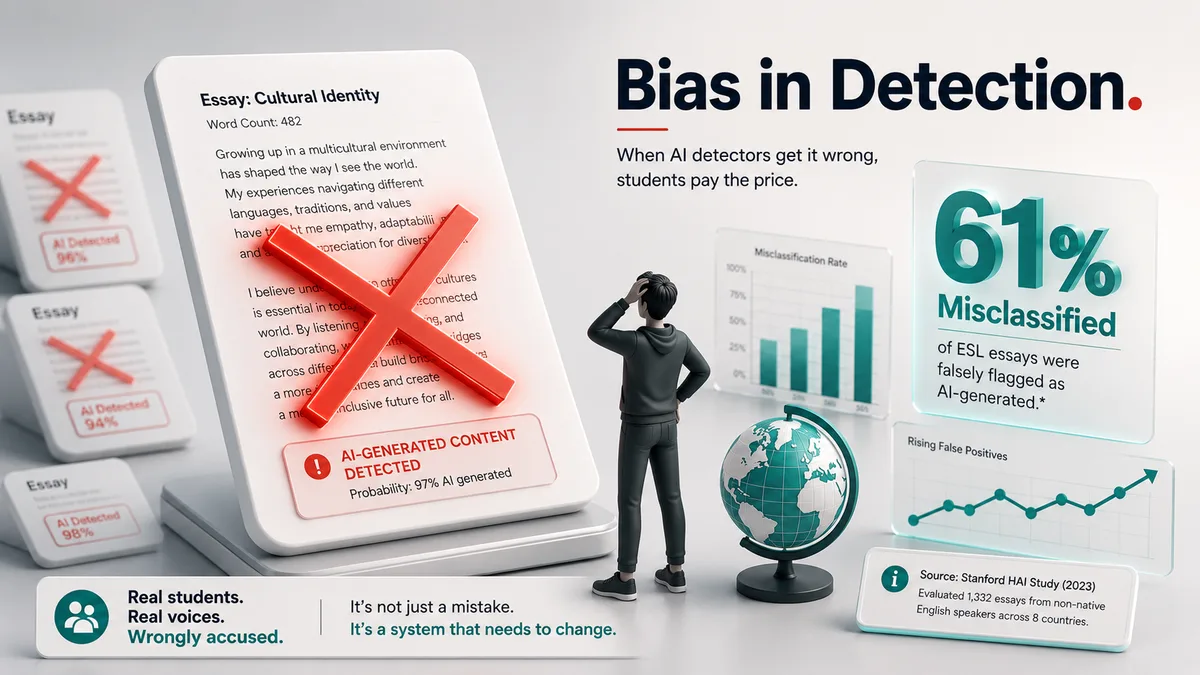
Universities and schools worldwide are deploying AI detectors to catch student cheating. The tools are marketed as accurate, impartial, reliable. For native English speakers, they're imperfect but workable.
For ESL students — those writing in English as a second, third, or fourth language — published research shows many of these tools produce results that border on discrimination.
This isn't hypothetical, and you don't have to take a detector vendor's word for it. Peer-reviewed research has measured the problem directly. The numbers should alarm every educator who's deployed one of these tools without understanding this specific failure mode.
The Core Problem: Why ESL Writing Looks "AI-Like" to Detectors
AI detectors measure statistical patterns in text. Two signals do most of the work:
Perplexity: how "surprising" the text is. Low perplexity means predictable word choices; high perplexity means unexpected, creative language. AI models default to low perplexity because they always pick the statistically likely next word.
Burstiness: how much sentence length varies within a passage. Humans mix short, punchy sentences with long, complex ones. AI produces uniform sentence structures — low burstiness.
Here's the problem: ESL writers, particularly those trained in academic traditions that prize formal, uniform writing, also produce low burstiness and predictable vocabulary. A student from Pakistan, India, or China taught that "formal academic writing requires consistent structure" will write text that looks statistically AI-like — not because they used AI, but because they were taught to write that way.
Native speakers writing casually — contractions, fragments, tonal shifts — get flagged less. Non-native speakers writing carefully and formally get flagged more. That's not a neutral outcome.
What the Research Actually Found
The landmark study is Stanford's: "GPT detectors are biased against non-native English writers" (Liang et al., Patterns, 2023). Researchers ran 91 real TOEFL essays — written by human, non-native English speakers — through seven widely used GPT detectors.
The results:
- On average, the detectors misclassified 61% of genuinely human TOEFL essays as AI-generated.
- Roughly one in five essays was unanimously flagged as AI by all seven detectors.
- The same detectors performed near-perfectly on essays written by native-speaking US eighth graders.
Read that again: essays written by real students, before ChatGPT even existed in its current form, flagged as machine-generated — purely because of how non-native English reads statistically.
The industry has quietly conceded the broader reliability problem. OpenAI discontinued its own AI text classifier in July 2023, citing low accuracy. Vanderbilt University publicly disabled Turnitin's AI detector that same year, stating that the risk of falsely accusing students outweighed the benefit (Vanderbilt's statement).
The Real-World Consequences
A high false-positive rate doesn't sound catastrophic in the abstract. In practice:
- A class of 30 ESL students submits essays. A detector behaving like the ones in the Stanford study could wrongly flag a large share of them.
- Academic integrity investigations get triggered. Students have to defend themselves.
- International students risk their visa status over academic penalties.
- Students who didn't cheat carry the burden of proving innocence — nearly impossible, since the tool's verdict gets treated as evidence.
Documented cases exist across the UK, US, and Australia of international students facing academic penalties based heavily on AI detector output. Several universities have since paused or disabled AI detection pending better tooling.
What Educators Should Do
1. Never base a penalty decision solely on AI detector output. Treat it as one signal among many, not evidence — our advice, even though we build a detector.
2. Apply extra scrutiny to ESL student work. The statistical patterns your detector flags as "AI-like" may simply be formal, non-native English.
3. Prefer sentence-level output over a single score. An essay flagged uniformly at moderate probability is consistent with ESL writing. Specific sentences flagged at high confidence while the rest reads clearly human is more consistent with AI insertion. A single document-level percentage can't show you that difference.
4. Compare multiple detectors. One tool flagging something as AI while another doesn't is itself evidence of uncertainty — not confirmation.
5. Talk to the student before concluding anything. Ask about their drafting process, check revision history in Google Docs or Word, compare against their in-class writing. Those signals beat any statistical score.
How QuillBotAI Pro Approaches the ESL Problem
We built QuillBotAI Pro after reading this research. It shaped two design decisions.
Multiple signals per sentence, not one verdict. Plain vocabulary alone doesn't trigger a flag. The analysis weighs word predictability, sentence-length variation, vocabulary spread, and model-typical phrasing together, per sentence, and reports a confidence level — so a formally written human paragraph produces "low confidence" ambiguity instead of a confident false accusation.
Non-native and multilingual context. QuillBotAI Pro explicitly supports Urdu, Roman Urdu, and Hindi-influenced English, recognizing that code-switching and bilingual writing patterns need different baselines than US-native English prose.
One honest caveat: this reduces the false-positive problem; it doesn't eliminate it. No detector can. Treat any sentence-level flag on ESL writing as a question to investigate, not an answer.
If you're an educator, see our full guide to AI detection for teachers for a step-by-step responsible workflow. If you're a student checking your own writing first, see our guide for students.
FAQ
Do AI detectors have higher false-positive rates for ESL students? Yes — dramatically higher, per peer-reviewed research. The Stanford study (Liang et al., 2023) found seven popular GPT detectors misclassified an average of 61% of genuine human TOEFL essays as AI-generated, while performing near-perfectly on native-speaker essays.
Why does AI detection flag ESL writing as AI-generated? ESL writers often produce text with low perplexity and low burstiness — predictable word choices, uniform sentence structure. Those are the same signals AI detectors use to flag machine-generated text. The overlap causes false positives.
Which AI detector is safest for ESL student work? No detector is "safe" enough to act as sole evidence. The safer choices show per-sentence confidence instead of one blunt score, and are designed with non-native English in mind — then treat the output as a conversation starter, not a verdict. Our academic integrity detector is built around exactly this workflow, and the methodology and its limits are documented in full.
If you've been flagged yourself, we've written a step-by-step guide to responding to a false accusation. For the wider picture on what detectors can and can't establish, see can a teacher actually prove AI use? and our complete guide to how AI detection works.
Should universities use AI detectors to check ESL student work? With extreme caution. Given the documented false-positive rates on ESL writing, detector output should never be primary evidence in an academic integrity decision. Some institutions, including Vanderbilt, have disabled AI detection entirely for this reason.
Is there a free AI detector designed for non-native English writing? QuillBotAI Pro is free, requires no signup, shows per-sentence confidence, and supports Urdu, Roman Urdu, and Hindi-influenced English. It reduces — but can't eliminate — the ESL false-positive problem, and says so plainly in the results.
Topics
Written & Reviewed By Experts
Zoe Parker
AuthorFounder & Lead AI Research Scientist, QuillBotAI Pro
NLP Specialization · DeepLearning.AI via Coursera (2024–2025)
Zoe is the founder of QuillBotAI Pro and leads its detection research. Her work focuses on computational linguistics and identifying how large language models produce text.
Editorial policy: All QuillBotAI Pro articles are written by domain experts, independently peer-reviewed, and updated as new research emerges. We never accept sponsored content that influences editorial conclusions.