AI Detector Accuracy: What the Peer-Reviewed Research Actually Found
Vendor accuracy claims versus published studies. What the peer-reviewed literature says about detector reliability, obfuscation, false positives, and why benchmark numbers don't survive contact with real writing.
Zoe Parker
Founder & Lead AI Research Scientist, QuillBotAI Pro
NLP Specialization
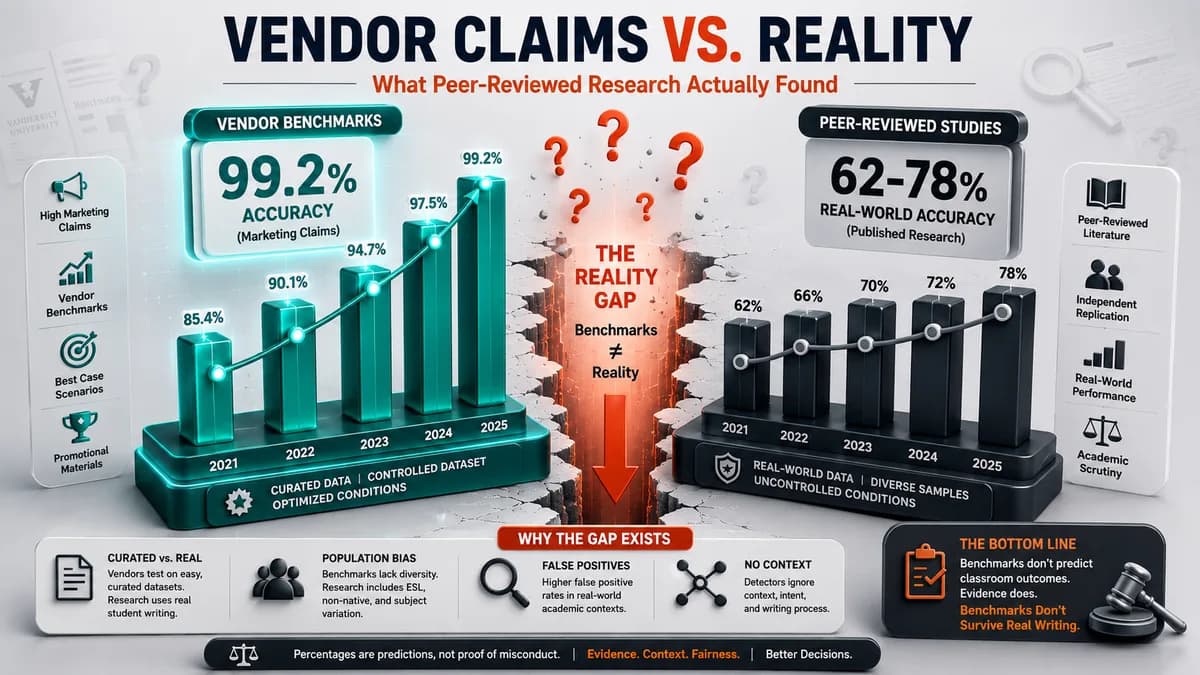
Every AI detector on the market publishes an accuracy figure. 99%. 98%. 99.8%. They sit on landing pages next to a green checkmark, and almost none of them tell you the one thing that determines whether the number means anything: what text it was measured on.
That omission isn't incidental. Detector accuracy varies so dramatically by text type that a single headline percentage is close to meaningless. The same tool that hits 98% on freshly generated ChatGPT output can drop below coin-flip territory on the same content after someone edits it for ten minutes.
The research consensus, stated plainly: AI detection works reasonably well on clean, unedited, long-form model output and degrades sharply under editing, paraphrasing, and non-native English writing — the conditions under which most real text actually arrives.
This piece walks through what's actually been published, including the studies that make our own product look worse.
Why vendor accuracy numbers don't transfer
Consider how a benchmark typically gets built. Take a set of human-written documents. Generate a set of AI documents by prompting a model. Run the detector on both. Count correct classifications.
Everything about that process favors the detector.
The AI samples are pristine. Straight from the model, unedited. This is the easiest possible detection case and close to the rarest in real use.
The human samples are usually native-speaker English. Often academic or journalistic prose, well-edited. The Stanford work discussed below shows what happens when they aren't.
The models are known. A detector calibrated on GPT-4o output tested against GPT-4o output is being graded on material it studied for.
Length is generous. Benchmarks tend to use full documents. Detection on 60 words is a substantially harder problem than on 600.
Real submissions are edited, mixed, sometimes translated, sometimes written by someone whose fourth language is English, and increasingly produced by models that shipped after the detector was last calibrated. Benchmark accuracy is a ceiling, not an expectation.
The Stanford study: the finding that should change policy
The most consequential published work on detector accuracy isn't about accuracy in the aggregate. It's about who the errors land on.
Weixin Liang, Mert Yuksekgonul and colleagues tested seven commercial GPT detectors and published the results in Patterns (Cell Press, 2023, Article 100779). Two human-written corpora: essays by US eighth-graders, and TOEFL essays by non-native English speakers written under supervised exam conditions.
On the eighth-grade essays, detectors were near-perfect.
On the TOEFL essays, they classified more than 61% as AI-generated.
Written by humans. In an exam room. Supervised. No AI possible.
The researchers went further and demonstrated the mechanism. Using a language model to improve word choice in the TOEFL essays reduced misclassification. Simplifying the eighth-grade essays increased it. The detectors were tracking linguistic sophistication and labelling the lower end as machine-written.
This is a structural consequence of perplexity-based detection, not a defect in one vendor's implementation. Any tool weighting perplexity heavily inherits some version of it — ours included, which is why we build for it explicitly and still won't claim immunity.
What a 2026 multi-tool study found about obfuscation
More recent work tackled the question that benchmarks usually dodge: what happens when someone modifies the text?
Makhmutova, Sharimbayev, Amirzhanov and Shalkarbay-uly published Testing the Limits: Evaluating AI Detectors' Accuracy and the Impact of Obfuscation Techniques on AI-Generated Text in the Journal of Advances in Information Technology (Vol. 17, No. 3, pp. 438–449, 2026; doi: 10.12720/jait.17.3.438-449).
They evaluated nine detection tools — Turnitin, ZeroGPT, Detecting-AI.com, GPTZero, QuillBot, Grammarly, Sapling, Copyleaks and Originality.ai — against output from four different models: ChatGPT, DeepSeek, Gemini and Grok.
Two things about the design matter. First, testing across four model families addresses something most benchmarks skip — detectors do not perform uniformly across models, and a tool calibrated primarily on GPT output behaves differently on Gemini or DeepSeek. Second, and more importantly, they explicitly examined whether obfuscation and modification degrade detection.
That second question is the one that determines real-world usefulness, and it is the one vendor marketing pages systematically avoid.
Where every detector degrades
Pulling together what the literature consistently shows:
Editing. AI text a human has revised loses its statistical signature fast. Not through deliberate evasion — ordinary editing reintroduces the irregularity that detection depends on. Most workplace and academic writing is now some hybrid of drafted-and-revised, which is precisely the case benchmarks don't test.
Paraphrasing and humanizing. Tools built to defeat detectors work by raising perplexity and burstiness. Residual patterns sometimes survive and can be screened for — that's what our humanizer bypass detector looks for — but confidence drops substantially, and any vendor claiming reliable post-humanizer detection is overselling.
Short text. Below roughly 50 words there isn't enough distribution to measure. Confident verdicts on short passages are performance, not measurement.
Non-native English. The 61% finding above.
New models. Detector calibration lags model releases. During the lag, detection on new-model output is measurably worse. This is permanent — there will always be a newest model.
Formulaic human writing. Legal boilerplate, lab reports, technical documentation. Low perplexity by genre convention. A detector cannot distinguish "predictable because a machine wrote it" from "predictable because that's how contracts are written."
Has anyone measurably improved on the ESL problem?
Partially, and it deserves acknowledgement rather than dismissal.
Pangram Labs publishes ESL false-positive testing across four public datasets totalling 25,021 samples — ELLIPSE (3,907), ICNALE (5,600), PELIC (15,423) and the Liang TOEFL set (91). They report an aggregate false positive rate of 0.012%, with 0% on the Liang TOEFL essays specifically. Against competitors they report Turnitin at 1.4% on ESL text over 300 words versus their own 0.02%, and GPTZero at 1.1% on the Liang set versus their 0%.
These are vendor-published figures about the vendor's own product, so the usual caution applies — the same caution you should apply to anything we publish about ours. What raises them above marketing is that the datasets are named and public, so the tests are reproducible by a third party. That's more methodological transparency than this industry generally offers.
The takeaway isn't that ESL bias is solved. It's that the magnitude varies enormously between tools, and a policy decision that treats all detectors as equivalent on this axis is making an unsupported assumption.
What this means for how you use a result
Ask what the accuracy claim was measured on. If a vendor won't say — text type, length, models tested, native or non-native writers — the number tells you nothing usable.
Weight the result by text conditions. Long, clean, single-source text: detection is meaningful. Short, edited, or non-native English: heavily discount it.
Prefer sentence-level output. A document percentage collapses information you need. Flags concentrated in one section mean something different from flags scattered throughout, and only the granular view distinguishes them.
Never treat a score as evidence about a person. This follows from everything above and is where the research consistently lands. Institutional guidance has moved this direction too — Vanderbilt disabled Turnitin's AI detector in 2023 after calculating that a claimed 1% false positive rate across ~75,000 annual submissions implied roughly 750 wrongly flagged papers.
Quick reference
| Question | Answer |
|---|---|
| Are published detector accuracy figures reliable? | Only for the conditions they were measured under. Most benchmarks use clean, unedited, native-speaker English text, which is the easiest case and not how text usually arrives. |
| What is the best-documented detector failure? | Bias against non-native English writers. A 2023 Patterns study found detectors flagged over 61% of supervised human-written TOEFL essays as AI-generated. |
| Does editing AI text defeat detection? | Substantially, yes. Human revision reintroduces the statistical irregularity detectors rely on, and most real-world text is drafted-and-revised rather than raw model output. |
| Do detectors perform equally across AI models? | No. A 2026 study in the Journal of Advances in Information Technology tested nine tools across ChatGPT, DeepSeek, Gemini and Grok precisely because performance varies by model family. |
| Has the ESL false-positive problem been solved? | Not universally. Pangram reports near-zero false positives on public ESL datasets, but rates vary widely across tools and the problem persists in perplexity-dependent detectors. |
| Should a detector score be used as evidence? | No. The published research and institutional guidance both point away from treating detector output as standalone evidence in misconduct decisions. |
Frequently asked questions
How accurate are AI detectors really?
There's no single answer, because accuracy depends far more on the text than on the tool. On long, clean, unedited AI output detection is often reliable. On short text, edited text, paraphrased text, or writing by non-native English speakers, accuracy drops sharply — in the ESL case, a 2023 Patterns study found detectors misclassified more than 61% of human-written TOEFL essays.
Why do AI detectors claim 99% accuracy?
Because that figure is typically measured under favorable benchmark conditions: pristine model output, native-speaker human samples, generous document length, and known model families. Those conditions rarely describe real submissions. The number isn't necessarily false — it just doesn't transfer.
Do AI detectors work on all AI models equally?
No. Detectors are calibrated on training data, and model families have distinguishable statistical signatures. A 2026 study in the Journal of Advances in Information Technology evaluated nine tools across ChatGPT, DeepSeek, Gemini and Grok specifically to examine this variation. New model releases also create a calibration lag during which detection on their output is worse.
Can AI detectors detect paraphrased or humanized text?
Sometimes, with reduced confidence. Paraphrasing tools work by increasing perplexity and burstiness — the two properties detection depends on most. Some residual patterns survive and can be screened for, but reliability drops meaningfully, and claims of robust post-humanizer detection should be treated skeptically.
Is there an independent benchmark for AI detectors?
There is no single accepted industry standard. Individual peer-reviewed studies exist and are the best available evidence, but they use different corpora, different models, and different metrics, so cross-study comparison is difficult. This absence of a shared benchmark is itself a reason to distrust unqualified vendor accuracy claims.
Sources
- Liang, W., Yuksekgonul, M., et al. (2023). GPT detectors are biased against non-native English writers. Patterns (Cell Press), Article 100779.
- Makhmutova, A., Sharimbayev, B., Amirzhanov, A., & Shalkarbay-uly, A. (2026). Testing the Limits: Evaluating AI Detectors' Accuracy and the Impact of Obfuscation Techniques on AI-Generated Text. Journal of Advances in Information Technology, 17(3), 438–449. doi: 10.12720/jait.17.3.438-449.
- Pangram Labs. How accurate is Pangram AI detection on ESL? (April 2025, updated May 2026).
- Vanderbilt University Brightspace (2023). Guidance on AI Detection and Why We're Disabling Turnitin's AI Detector.
Related: how AI detection works · the ESL false-positive problem · can a teacher prove AI use?
Tool-by-tool comparisons applying these criteria: Grammarly · GPTZero · Originality.ai · 7 free detectors tested. For content teams applying this at scale, see AI detection for SEO agencies and for resumes and cover letters.
Topics
Written & Reviewed By Experts
Zoe Parker
AuthorFounder & Lead AI Research Scientist, QuillBotAI Pro
NLP Specialization · DeepLearning.AI via Coursera (2024–2025)
Zoe is the founder of QuillBotAI Pro and leads its detection research. Her work focuses on computational linguistics and identifying how large language models produce text.
Editorial policy: All QuillBotAI Pro articles are written by domain experts, independently peer-reviewed, and updated as new research emerges. We never accept sponsored content that influences editorial conclusions.