Free SynthID Checker:
Detect Google AI Watermarks Instantly
Upload any image and run instant SynthID AI watermark detection — our free checker scans for Google Imagen 3, Gemini, and Veo signatures using spatial-frequency forensic analysis. No login, no upload limit, results in under 30 seconds.
Used by journalists, educators, and content teams to verify AI image provenance.
Imagen 3
Google AI Models
Gemini
Multimodal AI
Fast
Generation Speed
Free
No Signup
SynthID AI Watermark Detection — Upload & Scan
Drop any image below. The SynthID checker maps pixel-level signatures and frequency anomalies to identify Google SynthID watermarks instantly.
About this tool: Built by QuillBotAI Pro, an AI content analysis platform. Our SynthID detection pipeline analyzes spatial-frequency domains against the embedding patterns documented in Google DeepMind's SynthID research. Images are processed in volatile memory and never stored or logged.
Detect invisible digital watermarks injected by Google Imagen, Midjourney, DALL-E, and other generative pipelines. Fully private — no images are stored.
Drag & drop your image or video here
Supports PNG, JPG, WebP, MP4, WebM up to 22 MB
Or try a demo preset
Awaiting Upload
Upload an image or video on the left to run pixel-frequency analysis and SynthID watermark detection.
Deep Forensic Analysis of Google SynthID
Learn why imperceptible watermarking is the gold standard for content authenticity, search ranking compliance, and safe AI integration.
How SynthID Watermarking Works
Google SynthID embeds a digital signature directly into pixel-value variations of images. Unlike metadata tags — which are lost when files are cropped or compressed — SynthID alters subtle visual noise patterns in the frequency domain, mathematically engineered to be imperceptible yet perfectly decodable.
By analyzing these spatial-frequency distributions, our scanner discovers these hidden layers instantly, certifying whether the asset was generated inside Google Imagen or similar diffusion pipelines.
Why Validate AI-Generated Visuals?
Search engines are upgrading their crawlers to inspect files for generative markers. Under Google's E-E-A-T criteria, undisclosed bulk AI media is subject to ranking penalties if it fails to establish genuine helpfulness.
Running a digital audit gives creators full control — confirm whether renders carry automatic embeds, structure appropriate markup, and pass search audits without friction.
Visual Watermark Format Comparison
How Google SynthID compares to metadata and overlay techniques
| Watermark Style | Robustness | Visibility | Detection Method |
|---|---|---|---|
| Google SynthID Latent | Ultra-High | Invisible to human eye | SynthID Scanner |
| EXIF / IPTC Metadata | Ultra-Low | Invisible to human eye | Deleted by any metadata stripper |
| Visible Logo Overlays | Medium | Highly visible / distracting | Visible in basic scan |
| Adversarial Visual Noise | High | Microscopic dither patterns | Machine visual learning |
What a SynthID Detection Result Looks Like
After scanning, the checker returns a forensic breakdown with confidence score, source model estimate, and SynthID signature status.
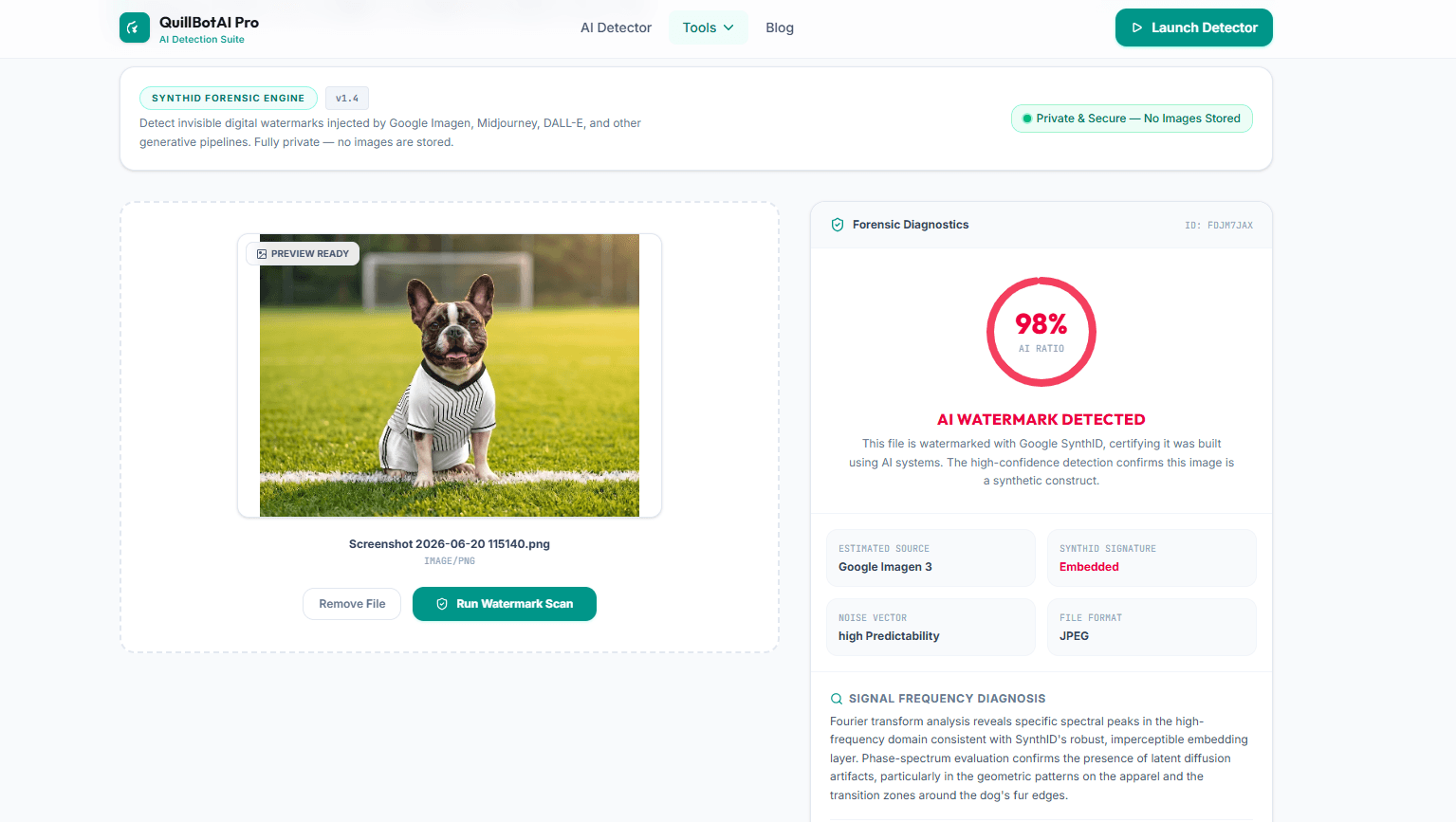
Example output: SynthID AI watermark detected with confidence score and source model identification.
How the SynthID Checker Works
Three steps from upload to verdict — SynthID AI watermark detection in under 30 seconds.
Upload Your Image
Drag and drop any JPG, PNG, or WebP file — up to 22 MB. No account or sign-up needed. Your image is analyzed in volatile memory and never stored.
Forensic Frequency Analysis
The SynthID checker decomposes the image into spatial-frequency components and runs a matched-filter scan against known Google SynthID embedding patterns from Imagen 3, Gemini, and Veo.
Read Your Watermark Verdict
You receive a clear result — detected, not detected, or inconclusive — with a confidence score. 'Detected' confirms the image passed through Google's AI generation pipeline.
What Is SynthID? Google's Invisible AI Watermark Explained
SynthID is Google DeepMind's invisible watermarking technology, launched in August 2023 and now embedded by default across Google's entire generative AI stack. Unlike traditional watermarks — visible logos or removable EXIF metadata — SynthID embeds a cryptographic noise signature directly into the pixel values of every image during generation itself. The signal is imperceptible to human eyes but mathematically detectable by a matched-filter scanner.
By mid-2026, more than 10 billion pieces of contenthave been SynthID-watermarked across Google's products — a figure confirmed in Google's SynthID Detector announcement. The technology now covers four content types:
Images — Google Imagen 3 & Gemini
Pixel-frequency noise embedded during diffusion
Video — Google Veo
Temporal markers in keyframe structures
Audio — Google Lyria
Spectral signatures in audio frequency bands
Text — Google Gemini
Token probability bias via bracket tournament
Our SynthID checker currently focuses on image watermark detection — the most widely deployed form and the one most relevant to journalists, educators, content teams, and compliance professionals.
How SynthID AI Watermark Detection Works — Technical Breakdown
Understanding what the SynthID checker is actually doing under the hood helps you interpret results — especially inconclusive verdicts.
Step 1 — Embedding at Generation Time
When Google Imagen 3 or Gemini generates an image, SynthID acts as a post-processor that slightly adjusts pixel values according to a learned pattern. The adjustment is spread across the entire canvas — not concentrated in one region — using frequency-domain channels selected to survive common transformations. The modification is below the threshold of human visual perception but above the noise floor that a detector needs.
Step 2 — Detection via Matched-Filter Correlation
The SynthID detector decomposes the uploaded image into its spatial-frequency components (similar to a discrete cosine transform), then correlates those components against the expected SynthID pattern using a trained neural network. The output is a probability score — not a binary flag — because the signal degrades with editing and compression. SynthID uses error-correction coding (similar in principle to QR codes) so partial signal presence still yields a valid detection.
Step 3 — Confidence Threshold and Verdict
Results above a high confidence threshold return detected. Results near the threshold return inconclusive — the watermark pattern is present but has been partially degraded. Results below the noise floor return not detected. An inconclusive result on an image you suspect is AI-generated is worth investigating further, as heavy JPEG compression or format conversion can push a genuine SynthID signal into the inconclusive band.
Why SynthID Watermarks Survive Screenshots and Compression
The most common question about SynthID AI watermark detection is whether simple image manipulation defeats it. The short answer: no — not under normal use conditions.
| Manipulation | Watermark Survives? | Why |
|---|---|---|
| Screenshot | Yes | Reproduces the same pixel values |
| JPEG compression (70–90% quality) | Yes | Quantization tables don't target SynthID's frequency channels |
| Format conversion (PNG → WebP → JPEG) | Yes | Pixel values preserved across conversions at standard settings |
| Cropping (center crop) | Yes | Watermark distributed across entire canvas — partial canvas retains signal |
| Resizing / downscaling | Usually | Moderate downscaling preserves frequency channels; extreme downscaling may degrade |
| JPEG compression (below 40% quality) | No | Extreme quantization destroys the frequency channels carrying the signal |
| Adversarial perturbation attacks | No | Targeted noise injection can remove signal but visibly degrades image quality |
The practical implication: any image you found online, received via messaging app, or downloaded from social media still carries its SynthID signature if it originated from a Google AI model — unless it has been through extreme lossy compression or a targeted adversarial attack, neither of which is standard behavior.
Who Needs a SynthID Checker?
SynthID AI watermark detection is relevant wherever image provenance matters — journalism, education, legal compliance, and content operations.
Journalists & Fact-Checkers
Verify whether a news image is AI-generated before publication. A SynthID-detected verdict is documented, auditable evidence of AI origin — stronger than visual judgment alone. As Google expands SynthID verification into Google Search and Chrome, editors who establish watermark-checking workflows now will be ahead of the new editorial standard.
Teachers & Academic Institutions
Check whether student-submitted images were AI-generated using Google Imagen 3 or Gemini. SynthID detection provides a concrete, explainable result to use in an academic integrity conversation — not an accusation based on instinct, but a documented forensic finding.
See our Academic Integrity guide for educators →Content & SEO Teams
Google's evolving core update criteria increasingly reward original, first-hand content — AI-generated images that carry SynthID signatures may face greater scrutiny as Google expands watermark-awareness in Search. Running a SynthID checker before indexing new image assets gives you the data you need to make disclosure decisions proactively.
Legal & Compliance Teams
California's AI Transparency Act (SB 942) mandates that large AI providers embed provenance data and supply free detection tools — requirements that took effect in 2026. Documenting SynthID detection results for marketing assets or licensed images is increasingly part of responsible AI use compliance. A clear 'not detected' result may be relevant to demonstrating human authorship in copyright contexts.
SynthID vs. C2PA — Two Approaches to AI Content Provenance
SynthID is one of two major AI content provenance standards in wide use as of 2026. Understanding the difference matters when interpreting detection results.
Google SynthID
- Embedded invisibly into pixel values at generation time
- Survives screenshots, compression, and format conversion
- Cannot be stripped without degrading image quality
- Verifiable by any SynthID-compatible detector
- Only covers content generated by Google AI models
C2PA Content Credentials
- Cryptographically signed metadata attached to the file
- Records full provenance chain — who created, edited, and published
- Adopted by Adobe, Microsoft, Intel, BBC, and OpenAI
- Removed if metadata is stripped (not pixel-embedded)
- Broader scope: covers human-edited and AI-generated content
SynthID and C2PA are complementary, not competing — Google supports both. Our SynthID checker detects the pixel-embedded watermark. For C2PA credential verification, tools like Adobe's Content Authenticity Initiative inspector are the right choice.
Limitations of SynthID Detection — What the Checker Cannot Do
Non-Google AI models are not detected
Midjourney, DALL-E 3, Stable Diffusion, Adobe Firefly, and Flux do not use SynthID. A 'not detected' result does not confirm the image is human-made — it confirms only that no Google SynthID signature is present.
Heavily human-edited AI images may return inconclusive
If an AI-generated image has been substantially reworked in Photoshop — retextured, repainted, or composited — the SynthID signal may degrade below the detection threshold. The checker will return inconclusive or not detected for heavily modified images.
Extreme compression defeats detection
JPEG quality settings below approximately 40% or aggressive WebP lossy compression can destroy the frequency channels carrying the SynthID signal. Images shared across platforms that apply heavy automatic compression may return false negatives.
Detection requires the full image
Unlike C2PA metadata, SynthID's signal depends on the pixel values being intact. Watermarking information cannot be 'read' from a partial crop if the crop is too small and the signal distribution is disrupted.
For images where the verdict matters — legal, editorial, or academic contexts — run the check on the highest-quality version of the file available and treat an inconclusive result as grounds for further investigation, not as a clear negative.
Frequently Asked Questions
What is a SynthID checker?
A SynthID checker is a tool that scans images for Google DeepMind's invisible AI watermark. It analyzes spatial-frequency noise patterns embedded during image generation by Google Imagen 3 and Gemini — patterns that are imperceptible to humans but mathematically detectable. Our free SynthID checker runs this forensic analysis in seconds and returns a clear verdict: watermark detected, not detected, or inconclusive.
How does SynthID AI watermark detection work?
SynthID AI watermark detection works by correlating the image's pixel-frequency domain against known SynthID embedding patterns. During image generation, Google's models embed a statistical noise signature into specific frequency channels across the entire image canvas. The detector performs a matched-filter analysis — scanning those same channels and measuring whether the expected pattern is present above a confidence threshold. The result is a probability score, not a binary yes/no, because compression and editing can partially degrade the signal.
Is there a free SynthID detector online?
Yes. QuillBotAI Pro's SynthID checker is 100% free with no account required. Upload any JPG, PNG, or WebP image and receive an instant SynthID AI watermark detection result. Google also runs an official detector at synthid.google.com, but it is limited to content generated by Google's own tools. Our tool accepts any image.
Does SynthID watermark survive compression and screenshots?
Yes — in most cases. SynthID is embedded across the entire pixel canvas rather than in a metadata layer, so standard JPEG compression at typical quality settings (70–90%), format conversion, and screenshotting all preserve the underlying signal. The watermark degrades significantly only under extreme lossy compression (JPEG quality below ~40%), adversarial perturbation attacks, or heavy noise filters — none of which produce a usable image under normal conditions.
What does a SynthID detection result mean?
'Detected' means the image carries a Google SynthID signature and was generated or processed by a Google AI model such as Imagen 3, Gemini, or Veo. 'Not detected' means no SynthID signature was found — but this does not confirm the image is human-made; AI tools from other vendors (Midjourney, DALL-E, Stable Diffusion) do not use SynthID. 'Inconclusive' means the signal is present but below the confidence threshold, typically due to heavy compression or editing.
Which AI models use SynthID watermarking?
As of 2026, SynthID is embedded by default across Google's full generative AI stack: Imagen 3 (images), Gemini (text), Veo (video), and Lyria (audio). More than 10 billion pieces of content have been SynthID-watermarked since the technology launched in 2023. OpenAI, ElevenLabs, and Kakao have adopted compatible watermarking standards, but their signatures use different embedding approaches and are detected separately.