Can a Teacher Actually Prove You Used AI? What a Detector Score Does and Doesn't Establish
A detector percentage is not evidence. What AI detection can legitimately support in an academic integrity case, what it can't, and why universities like Vanderbilt turned theirs off.
Zoe Parker
Founder & Lead AI Research Scientist, QuillBotAI Pro
NLP Specialization
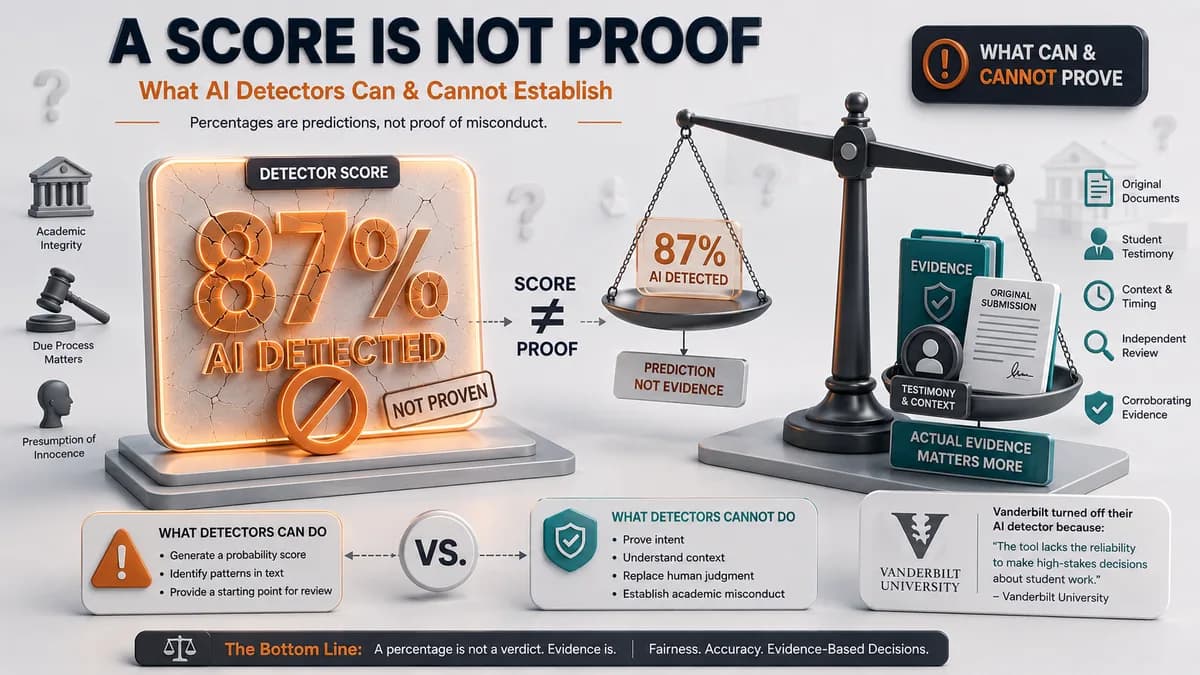
A student sits across from a professor who has a printout with a number on it. The number is 89%. The professor asks the student to explain.
The uncomfortable thing about that scene — and it plays out constantly now — is that the number cannot do the work being asked of it. It looks like evidence. It has a decimal-point authority to it. But an AI detection score is a probability estimate about statistical patterns, and it points at no source, no record, and no act. There is nothing behind it to examine.
A detector score cannot prove someone used AI. It can indicate that text has statistical properties common in model-generated writing. That is a meaningfully different claim, and the gap between the two is where academic integrity cases go wrong.
This piece is about what that gap actually contains — for teachers deciding how much weight to give a result, and for students trying to understand what they're facing.
Why a percentage isn't evidence
Plagiarism detection produces evidence. It finds a passage in a student's essay, matches it to a published source, and shows you both. You can read the original. You can see the overlap. The claim is verifiable by anyone who looks.
AI detection has no equivalent. There's no database of everything ChatGPT has written to match against — the model generates novel text each time. So a detector instead measures whether the writing behaves like model output: how predictable the word choices are, how much sentence length varies, whether certain phrasing patterns appear.
The output is a probability derived from those measurements. Ask what's behind an 89% and the honest answer is: a statistical distribution. Not a source. Not a log. Not a record of anything that happened.
That distinction sounds academic until you're the person being asked to disprove it. Which brings up the second problem.
The thing that makes accusations unfair
You cannot disprove a statistical claim about your own writing style.
If accused of plagiarism, a student can show their sources, walk through their notes, explain how they arrived at a passage. There's something to engage with.
If accused on a detector score, what exactly is the counter-argument? "I write like that"? The student's defense and the accusation are the same evidence — the text — read two different ways. And the burden has quietly moved onto the person with no way to discharge it.
This is why the framing matters so much. A detector result that opens a conversation is reasonable. A detector result presented as a finding is not, because the accused has no mechanism to answer it.
What the research says about getting it wrong
The most rigorous published work here is from Stanford. Weixin Liang, Mert Yuksekgonul and colleagues tested seven commercial GPT detectors against human-written text and published the results in Patterns (Cell Press, 2023, Article 100779).
Against essays by US eighth-graders, the detectors performed with near-perfect accuracy.
Against TOEFL essays — written by non-native English speakers, in exam conditions, under supervision — the detectors classified more than 61% as AI-generated.
Every one of those essays was human-written. The supervision is the part worth sitting with: there was no possibility of AI use, and the tools flagged the majority anyway.
The researchers identified the mechanism too. When they improved the word choice in TOEFL essays, misclassification dropped. When they simplified the eighth-grade essays, misclassification rose. The detectors were not measuring machine authorship. They were measuring linguistic sophistication and calling the lower end "AI."
For any institution with international students, that finding should determine policy on its own.
What Vanderbilt did about it
In August 2023, Vanderbilt University disabled Turnitin's AI detector and explained why in public.
Their reasoning was arithmetic. Turnitin claimed a 1% false positive rate. Vanderbilt had submitted around 75,000 papers to Turnitin the previous year. One percent of that is approximately 750 papers that could have been incorrectly flagged as containing AI-written material.
They also noted that the tool was enabled for customers with under 24 hours' notice, with no option to turn it off at the time, and no insight into how it worked. And they flagged the non-native English problem specifically.
Their conclusion was that AI detection software "is not an effective tool that should be used."
What makes Vanderbilt's decision worth citing isn't that they're unusual — a number of institutions have since made similar calls. It's that they showed the calculation. A 1% error rate sounds tolerable right up until you multiply it by enrollment.
What a detector result can legitimately do
None of this makes detection useless. It makes it a triage signal rather than a finding.
Reasonable uses:
Prompting a conversation. "I'd like to talk through how you approached this essay" is a fair thing to initiate after a high score. The conversation, not the score, is where you learn something.
Directing attention. If flagged sentences cluster in one section while the rest of a document reads clean, that's worth a closer look — a pasted chunk produces a different pattern than a uniformly high score, which more often reflects writing style.
Pattern-spotting across a set. Aggregate signals across many submissions can reveal something a single score can't.
Unreasonable uses:
As the basis for a grade penalty. The score establishes nothing about authorship.
As the case in a misconduct hearing. It cannot be examined, corroborated, or rebutted.
Applied uniformly across a diverse cohort. Given the 61% figure, a fixed threshold applied to a class with international students will systematically produce more false accusations among them. That's not a hypothetical risk; it's the documented behavior of these tools.
If you're a student who's been accused
Some practical ground, offered without pretending it's a comfortable situation.
Ask what the accusation actually rests on. If it's a detector score alone, it's reasonable to ask what the tool's documented false positive rate is on writing like yours.
Bring your drafting process. Version history in Google Docs or Word, notes, outlines, search history, earlier drafts. This is the closest thing to real counter-evidence — it shows the writing happening over time.
If English isn't your first language, say so and cite the research. The Liang study is peer-reviewed, published in a Cell Press journal, and directly on point. More than 61% of supervised human-written TOEFL essays were flagged. That's not a personal excuse; it's a documented property of the tools.
Ask whether your institution has a policy. Many now restrict or prohibit detector-based accusations. Vanderbilt's public statement is a useful reference point even at other institutions.
Request the sentence-level breakdown, not just the score. Which specific sentences were flagged? Are they in one section or spread throughout? Scattered flags across an entire document usually indicate a style penalty rather than pasted content.
Quick reference
| Question | Answer |
|---|---|
| Can a detector prove a student used AI? | No. It produces a probability estimate from statistical patterns and points to no source, record, or act. |
| Is AI detection like plagiarism detection? | No. Plagiarism detection produces a verifiable matching source; AI detection produces only a probability with nothing behind it to examine. |
| How often do detectors wrongly flag human writing? | It varies by writer. A 2023 Patterns study found detectors flagged over 61% of supervised, human-written TOEFL essays by non-native English speakers as AI-generated. |
| Why did Vanderbilt disable Turnitin's AI detector? | At Turnitin's claimed 1% false positive rate, Vanderbilt's ~75,000 annual submissions implied roughly 750 papers could be wrongly flagged. |
| What can a detector score legitimately be used for? | Starting a conversation about a student's drafting process — not as evidence in a misconduct decision. |
| What should a student bring if accused? | Version history, drafts, notes, and outlines that show the writing developing over time. |
Frequently asked questions
Can a teacher fail a student based only on an AI detector score?
They may have the institutional power to, but the score doesn't support the conclusion. A detector output is a statistical probability, not evidence of authorship, and it cannot be independently examined the way a plagiarism match can. A growing number of universities have restricted or disabled detector-based accusations for this reason.
What percentage on an AI detector counts as proof?
None. There is no threshold at which a probability estimate becomes evidence of what a person did. A higher score means the text more closely matches statistical patterns common in model output — which can also be produced by writing simply, writing formulaically, or writing in English as a second language.
Do universities still use AI detectors?
Many do, and many have stopped or restricted their use. Vanderbilt disabled Turnitin's AI detector in August 2023 and published its reasoning; other institutions have made comparable decisions since. Policies vary considerably, so it's worth checking your own institution's current stance rather than assuming.
How can a student prove they didn't use AI?
Strictly speaking, proving a negative about your own writing style isn't possible — which is the core unfairness of detector-based accusations. The strongest practical response is process evidence: document version history, drafts, notes, and outlines that show the work developing over time.
Are AI detectors biased against international students?
The research says yes for tools relying primarily on perplexity. The 2023 Patterns study found detectors misclassified more than 61% of human-written TOEFL essays while handling native-speaker essays almost perfectly, and traced the cause to the tools penalizing lower linguistic complexity rather than detecting machine authorship.
Sources
- Liang, W., Yuksekgonul, M., et al. (2023). GPT detectors are biased against non-native English writers. Patterns (Cell Press), Article 100779.
- Vanderbilt University Brightspace (2023). Guidance on AI Detection and Why We're Disabling Turnitin's AI Detector.
Related reading: how AI detection actually works, what the accuracy research found, the ESL false-positive research in depth, and our guidance for educators. If you're choosing a tool, the Grammarly comparison covers what sentence-level output changes about an investigation. The detector itself returns sentence-level output rather than a single score, precisely because a single number invites the misuse described above.
Topics
Written & Reviewed By Experts
Zoe Parker
AuthorFounder & Lead AI Research Scientist, QuillBotAI Pro
NLP Specialization · DeepLearning.AI via Coursera (2024–2025)
Zoe is the founder of QuillBotAI Pro and leads its detection research. Her work focuses on computational linguistics and identifying how large language models produce text.
Editorial policy: All QuillBotAI Pro articles are written by domain experts, independently peer-reviewed, and updated as new research emerges. We never accept sponsored content that influences editorial conclusions.