GPTZero vs QuillBotAI Pro: Which AI Detector Should You Use in 2026?
An honest comparison of GPTZero and QuillBotAI Pro — pricing, signup friction, sentence-level output, and ESL false positives — so you can pick the right tool.
Zoe Parker
Founder & Lead AI Research Scientist, QuillBotAI Pro
NLP Specialization
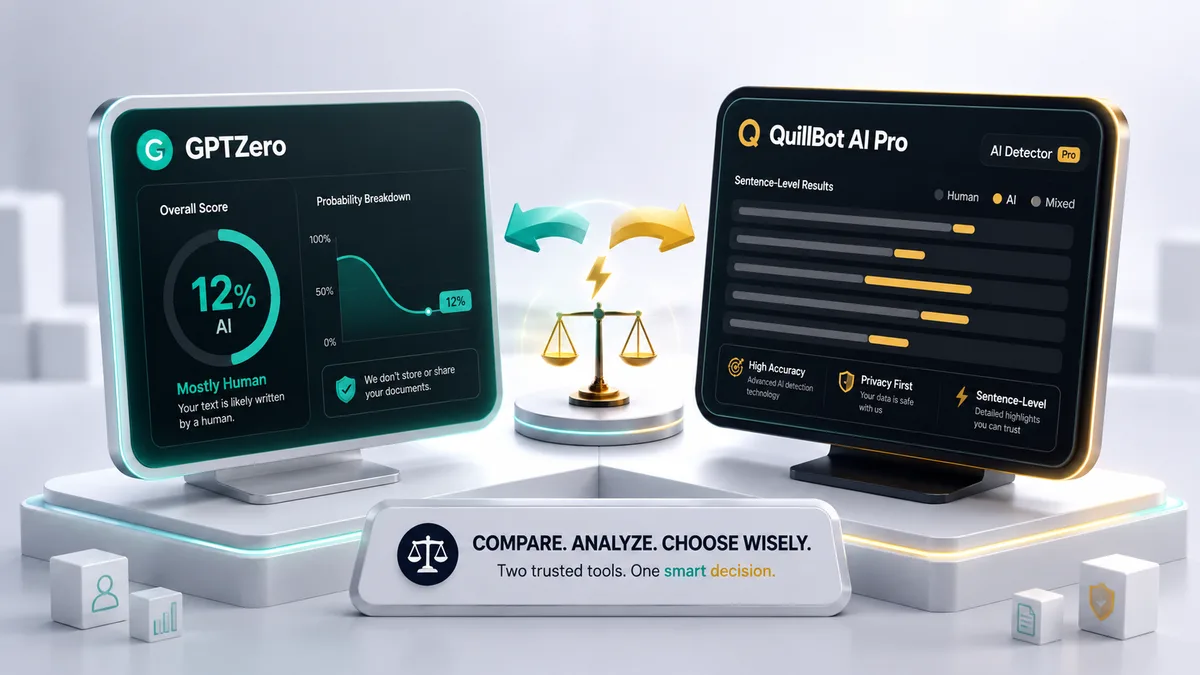
If you've searched for an AI detector, you've almost certainly landed on GPTZero. It's the most-cited tool in this space — used by universities, newsrooms, and content teams worldwide. But popularity and fit aren't the same thing.
Full disclosure up front: we build QuillBotAI Pro, so read this as a maker's comparison, not an independent lab report. We'll stick to differences you can verify yourself in five minutes — signup friction, word caps, output format, language handling — and link to independent research wherever accuracy claims need backing.
Quick Answer: GPTZero vs QuillBotAI Pro
| Feature | GPTZero | QuillBotAI Pro |
|---|---|---|
| Requires signup | Yes (free tier limited) | No |
| Free word limit | Capped free tier | Unlimited |
| Sentence-level heatmap | Paid tiers | Free |
| Urdu / Roman Urdu / Hindi support | No | Yes |
| Explains why a line was flagged | Partially | Yes, per sentence |
| Price | Free tier + paid plans | Free |
Bottom line: GPTZero is an established tool with real institutional adoption, an API, and paid team features. QuillBotAI Pro's case is simpler: sentence-level output with no account, no word cap, and calibration for non-native English — for free. Which one fits depends on what you're checking, and who wrote it.
What No Detector Will Tell You (But We Will)
Before comparing tools, one honest caveat that applies to both of them — and every other detector on the market:
No AI detector is reliable enough to be used as sole evidence against a writer. Detection is a statistical estimate. It works best on long, unedited, English-language AI output, and degrades on short texts, edited texts, and non-native English writing. Any tool that promises certainty is overselling.
That last point isn't our opinion. Stanford researchers found that popular GPT detectors misclassified the majority of TOEFL essays written by real, non-native English speakers as AI-generated, while performing near-perfectly on essays by native speakers (Liang et al., 2023, Patterns). Simpler vocabulary and regular sentence structure — completely normal in ESL writing — statistically resemble machine output to a naive detector.
This is why we built QuillBotAI Pro to weigh multiple signals per sentence and show confidence levels, rather than issuing one blunt verdict. It reduces the ESL false-positive problem; it doesn't eliminate it. Nothing does.
Where GPTZero Is Genuinely Strong
We're not going to pretend the market leader is bad at its job:
- Institutional trust. Many universities have standardized on GPTZero. If your institution already uses it, consistency across reports has real value.
- API and integrations. GPTZero offers API access and LMS integrations for automated workflows — QuillBotAI Pro doesn't, currently.
- Established track record. It's been publicly tested by third parties more than almost any other detector, which means its failure modes are well documented.
Where QuillBotAI Pro Is Different
- Zero friction. No account, no email, no word cap. Paste and scan. For a teacher checking a handful of essays a month, that's the difference between using a tool and abandoning it.
- Sentence-level heatmap, free. Instead of one percentage for the whole document, every sentence gets classified — human, mixed, or AI-like — with its own confidence level. You see which lines raised the flag and judge them yourself.
- Non-native English calibration. Built around the ESL false-positive problem documented in the Stanford research above, and it supports Urdu, Roman Urdu, and Hindi — languages most detectors ignore entirely.
- Honest confidence scores. Heavily edited or humanized text produces lower confidence, and the tool says so, instead of manufacturing certainty.
When to Use GPTZero
- Your institution has already standardized on it and needs consistency across reports
- You need API access or LMS integration for automated workflows
- You want an established brand name administrators will recognize
When to Use QuillBotAI Pro
- You're reviewing ESL or multilingual student writing and can't afford casual false accusations
- You want zero friction — no account, no limits, no credit card
- You want to see which sentences were flagged and why, not just one number
- You work with Urdu, Roman Urdu, or Hindi text
Verdict
GPTZero is a legitimate tool with genuine institutional adoption — if you need its API or its brand recognition, use it. QuillBotAI Pro competes on a different axis: transparent sentence-level results, fairness to non-native English writers, and completely free access with no account.
Our honest recommendation for high-stakes decisions — grades, hiring, discipline — stays the same regardless of which tool you pick: treat any detector's output as a starting point for a conversation, never as proof.
Try QuillBotAI Pro free — no signup required. Paste your text, get sentence-level analysis in seconds, and judge the flagged lines for yourself.
For other paid-vs-free comparisons, see Originality.ai vs QuillBotAI Pro, and for the ESL false-positive research referenced above, see our deep-dive on AI detector false positives and ESL writers.
Frequently Asked Questions
Is GPTZero accurate in 2026? GPTZero performs well on clean, unedited ChatGPT-style output in English — the easiest detection case for every tool. Like all detectors, its reliability drops on edited text, newer models it hasn't calibrated for, and non-native English writing. Independent research (Stanford, 2023) has documented that GPT detectors as a class misclassify a large share of ESL writing as AI.
Does GPTZero require an account? Yes — GPTZero's free tier requires registration and caps monthly words, with sentence-level analysis and higher limits behind paid plans. QuillBotAI Pro requires no account and has no word limits.
Which AI detector has the lowest false positive rate? No detector can honestly claim a universal false-positive rate — it varies enormously by text type, length, and the writer's language background. What you can compare is design: QuillBotAI Pro shows per-sentence confidence and is explicitly calibrated for non-native English writing, so a plain-English human sentence is less likely to get flagged on style alone.
Can GPTZero detect Claude AI writing? Detection of Claude output is harder than ChatGPT for every tool, because Claude writes with more natural sentence-length variation. Both GPTZero and QuillBotAI Pro attempt it; both are less reliable on Claude than on ChatGPT, so expect more "mixed" verdicts.
Is QuillBotAI Pro really free with no limits? Yes. QuillBotAI Pro is completely free, requires no signup, has no word caps, and includes the full sentence-level heatmap. All features are available without payment or registration.
Topics
Written & Reviewed By Experts
Zoe Parker
AuthorFounder & Lead AI Research Scientist, QuillBotAI Pro
NLP Specialization · DeepLearning.AI via Coursera (2024–2025)
Zoe is the founder of QuillBotAI Pro and leads its detection research. Her work focuses on computational linguistics and identifying how large language models produce text.
Editorial policy: All QuillBotAI Pro articles are written by domain experts, independently peer-reviewed, and updated as new research emerges. We never accept sponsored content that influences editorial conclusions.