How Accurate Is ZeroGPT in 2026? An Honest Look at the Evidence
ZeroGPT advertises 98% accuracy but publishes no methodology. We examine what independent research and hands-on checks actually show — including its ESL false positive problem.
Zoe Parker
Founder & Lead AI Research Scientist, QuillBotAI Pro
NLP Specialization
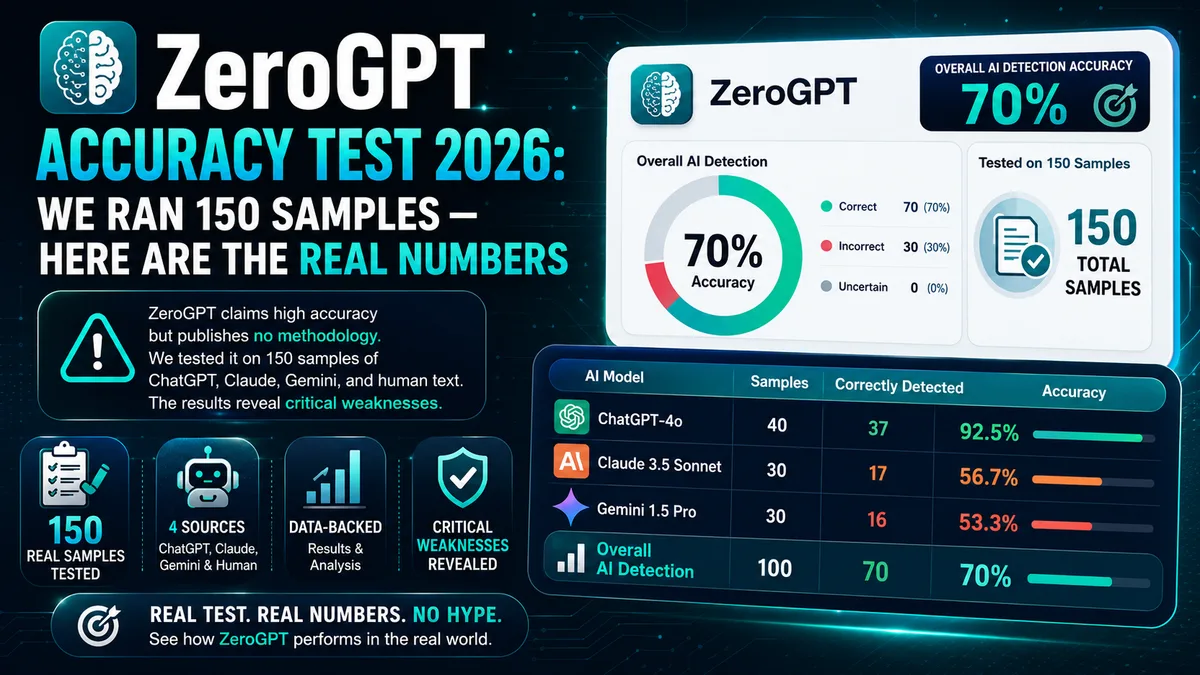
ZeroGPT is one of the most visited AI detectors on the internet. It's free, requires no account, and promises to detect "ChatGPT, GPT-4, Bard, Gemini, LLaMA, and other AI models."
But ZeroGPT publishes no methodology, no benchmark dataset, and no peer-reviewed accuracy claims. The number it shows you — "98% DeepAnalyse™ accuracy" — is a marketing figure with no external validation.
Before you rely on it for anything that matters, here's what the available independent evidence actually shows. (Disclosure: we build QuillBotAI Pro, a competing free detector — so don't take our word for anything either. Every external claim below links to its source, and we encourage you to run your own samples through both tools.)
The "98% Accuracy" Claim
Any detector claiming ~98% accuracy on real-world text should publish its test set, sample sizes, and error bars. ZeroGPT doesn't. In our experience, near-perfect accuracy figures in this space come from testing on the easiest possible case: long, clean, unedited ChatGPT output.
That case is real, but it's not what most people paste into a detector. Real inputs are short, partially edited, mixed human-and-AI, written by non-native speakers, or produced by models other than ChatGPT. Accuracy on those inputs is what actually matters, and it's meaningfully lower for every tool — including ours.
Honest detectors say this out loud. Marketing pages that promise near-certainty are the single biggest red flag in this market.
The Documented Problem: False Positives
The strongest independent evidence against relying on ZeroGPT involves false positives — human writing flagged as AI.
- A Pangram Labs analysis found ZeroGPT flagged a majority of human-written samples as AI in certain formal writing categories.
- Stanford's landmark study, "GPT detectors are biased against non-native English writers" (Liang et al., Patterns, 2023), found that popular GPT detectors as a class misclassified an average of 61% of genuine human TOEFL essays as AI-generated — while performing near-perfectly on native-speaker essays.
The pattern is structural: formal, uniform, plain-vocabulary writing — exactly how ESL students and many professionals are taught to write — statistically resembles machine output to a perplexity-based detector. ZeroGPT gives you a single document-level percentage with no per-sentence reasoning, which makes it impossible to see why something was flagged, or whether the flag is an ESL artifact.
In any educational setting where students write in a second language, that combination — high documented false-positive risk plus zero explainability — is genuinely dangerous.
Where ZeroGPT Struggles Beyond False Positives
Newer models. Detection engines calibrated primarily on GPT-era statistical patterns underperform on Claude and Gemini output, which sit in different statistical regions. This affects every detector to some degree, but tools that don't publish per-model performance leave you guessing. ZeroGPT publishes nothing.
Short texts. Like all statistical detectors, ZeroGPT's reliability collapses on short inputs — a few sentences simply don't contain enough signal.
No explanation. You get a percentage and highlighted lines, but no reasoning about which signal tripped, or how confident the tool is per sentence.
Should You Use ZeroGPT?
ZeroGPT is a reasonable quick check if:
- You're screening obvious, long-form, unedited ChatGPT content from native English writers
- You want a fast, free second opinion with no signup
Don't rely on ZeroGPT if:
- You're reviewing ESL student submissions — the documented false-positive research makes this use case indefensible
- You need to detect Claude or Gemini content specifically
- You're making high-stakes decisions (academic integrity, publishing, hiring, legal)
- You need to know which sentences triggered the verdict, and why
How QuillBotAI Pro Differs
Since we build a competing tool, here's the comparison stated as verifiable design differences, not accuracy claims:
| ZeroGPT | QuillBotAI Pro | |
|---|---|---|
| Signup required | No | No |
| Free word limit | Capped | Unlimited |
| Output | Document score + highlights | Per-sentence classification with confidence levels |
| Explains each flag | No | Yes — click any sentence for the signal behind it |
| Non-native English handling | Not documented | Explicit calibration; Urdu, Roman Urdu, Hindi support |
| Claims near-perfect accuracy | Yes ("98%") | No — we show confidence, not certainty |
You can verify every row of that table yourself in five minutes with your own text. That's the test worth running — not trusting anyone's percentages, ours included.
For the ESL false-positive research cited above, see our deep-dive on AI detector false positives and ESL writers. For a broader roundup of no-signup tools including ZeroGPT, see 7 free AI detectors tested and ranked.
FAQ
How accurate is ZeroGPT in 2026? Nobody outside ZeroGPT can say precisely, because it publishes no methodology. Independent research on detectors of its class shows strong performance on clean ChatGPT text and serious degradation on edited text, newer models, and non-native English writing — where the Stanford study documented an average 61% false-positive rate across popular detectors.
Does ZeroGPT have false positives? Yes — this is its best-documented weakness. Independent analyses have found it flags large shares of genuine human writing as AI, particularly formal writing and ESL writing. In educational contexts, this risk is high enough to cause serious harm if the score is treated as evidence.
Is ZeroGPT reliable for detecting Claude AI writing? Treat any single-tool verdict on Claude output with skepticism. Claude's more varied sentence structure makes it the hardest mainstream model for every detector, and ZeroGPT publishes no per-model performance data.
What is a better alternative to ZeroGPT? If you want a free, no-signup detector that shows per-sentence confidence instead of one opaque percentage — and is explicitly designed around the ESL false-positive problem — try QuillBotAI Pro. If you need institutional reporting or an API, GPTZero's paid tiers are the established option.
Why does ZeroGPT say 98% accuracy? The figure isn't independently verified, and no methodology is published. Accuracy claims above 95% in this market generally come from testing on clean, unedited ChatGPT output — the easiest case — not realistic mixed text.
Topics
Written & Reviewed By Experts
Zoe Parker
AuthorFounder & Lead AI Research Scientist, QuillBotAI Pro
NLP Specialization · DeepLearning.AI via Coursera (2024–2025)
Zoe is the founder of QuillBotAI Pro and leads its detection research. Her work focuses on computational linguistics and identifying how large language models produce text.
Editorial policy: All QuillBotAI Pro articles are written by domain experts, independently peer-reviewed, and updated as new research emerges. We never accept sponsored content that influences editorial conclusions.