Best AI Detector for SEO Agencies 2026 — Free & Fast
The only free AI detector built for high-volume SEO content. No signup, no character limit. Catch ChatGPT, Claude & Gemini text before it hits your client sites.
Zoe Parker
Founder & Lead AI Research Scientist, QuillBotAI Pro
NLP Specialization
SEO agencies are in an uncomfortable position in 2026. AI writing tools have made content production faster and cheaper than ever — but Google's Helpful Content System has gotten much better at spotting low-value, mass-produced content, and clients are getting nervous.
The practical question isn't "should we use AI?" Most agencies already do. The real question is: how do you maintain content quality at scale, avoid Google penalties, and verify that AI-assisted content is genuinely differentiated?
AI detection tools are one layer of that QA workflow. Here's how to use them properly.
What SEO Agencies Actually Need from an AI Detector
An agency running 50–500 pieces a month needs something different than an educator checking 30 essays a semester.
High-volume throughput. Word limits kill agency workflows. A tool that caps you at 1,500 words per check means splitting every 2,000-word article — doubling your QA time. You need unlimited or very high limits.
Sentence-level output, not just scores. A top-line "68% AI" score tells you nothing actionable. Sentence-level heatmaps tell your editor exactly which paragraphs to rewrite — the difference between a useful QA tool and a useless traffic light.
Accuracy on Claude and Gemini, not just ChatGPT. Your writers are probably using a mix of tools — ChatGPT, Claude, Gemini, Jasper, Copy.ai. A detector calibrated only on GPT output misses half your risk exposure.
Low false-positive rate on ESL writing. If you work with international writers — common for agencies sourcing from India, Pakistan, the Philippines, or Eastern Europe — a tool with a 30%+ false-positive rate will flag human writing as AI constantly. That breaks your workflow and demoralizes writers who did nothing wrong.
No per-scan costs at scale. At $0.01 per 100 words, a 2,000-word article costs $0.20. Cheap, until you're checking 300 articles a month — $60/month just for detection, before you've paid for the writing itself.
AI Detection Tools for Content Agencies: Ranked
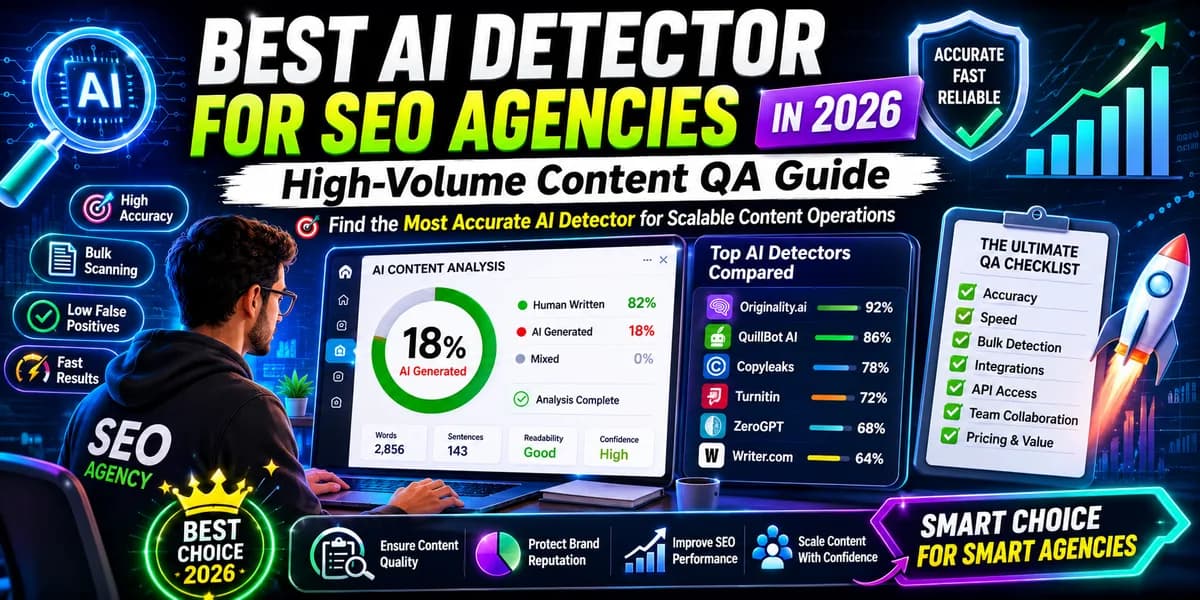
1. QuillBotAI Pro (Free) — Best for Unlimited Volume
Best for: Agencies that need unlimited free checks with sentence-level analysis Word limit: Unlimited Cost: Free Signup: No
Our AI writing detector offers sentence-level heatmaps with no word limits and no per-scan cost. For agencies running high content volumes, that gives editors output they can act on line by line rather than a single document score.
Detection covers ChatGPT-4o, GPT-5, Claude 3.5 Sonnet, Gemini 1.5 Pro, Llama 3, and Mistral. Model-specific fingerprinting means you're not getting a generic "this looks AI-ish" score — you're getting calibrated detection for whatever tool your writers are actually using.
It's also explicitly calibrated for non-native English writing — critical for agencies with international teams, given the well-documented tendency of detectors to flag ESL writing as AI (Stanford's Liang et al. 2023 study found detectors misclassified an average of 61% of genuine human TOEFL essays).
Limitation: No API access. It's manual paste-and-scan for now — if you need automated pipeline integration, you'll want a paid tool with API access.
2. Originality.ai ($20/month) — Best for API Pipelines
Best for: Agencies building automated content QA workflows Word limit: Unlimited on paid plans Cost: $20/month or $0.01/100 words pay-as-you-go API: Yes
Originality.ai's real edge over free tools is API access. If you're building a workflow where content flows straight from your CMS into a detection queue with no manual step, this is what makes that possible.
On detection quality: treat Originality.ai's published accuracy claims the way you should treat anyone's, ours included — as vendor numbers to verify against your own content mix. If your writers are international, test it on known-human ESL drafts before you trust its flags.
The bundled plagiarism detection is genuinely useful if you need to check originality and AI-assistance in the same pass.
3. Copyleaks ($16+/month) — Best for Plagiarism + AI Combo
Best for: Agencies that need both plagiarism and AI detection in one tool Cost: From $16/month API: Yes (higher tiers)
Copyleaks combines plagiarism detection (checked against a large web index) with AI detection in one interface. If your QA workflow currently runs separate tools for each, consolidating here cuts a step out.
As with every detector, verify its behavior on your own writers' known-human drafts before you enforce it — false positives on formal, non-native English writing are an industry-wide problem, and they cause real friction with international teams.
How Google Actually Treats AI Content (And What Detection Has to Do with It)
Google's position, stated clearly in the March 2024 Helpful Content System update, is that it targets low-value content — not AI content specifically.
What gets penalized:
- Mass-produced content with no unique insight or original research
- Content that exists to rank, not to genuinely help a reader
- Content that fails E-E-A-T (Experience, Expertise, Authoritativeness, Trustworthiness)
What doesn't get penalized:
- AI-assisted content that demonstrates genuine expertise and original perspective
- AI-drafted content substantially reviewed and edited by a domain expert
- Content that matches search intent and provides genuine value
What this means for agencies: AI detection isn't about proving your content is "human-written." It's about finding the segments that are low-value, generic, and unrevised. A high AI detection score on a segment usually means that segment is statistically formulaic — which tends to be the same thing as unhelpful.
Use AI detection to flag generic sections for editorial revision, not to prove or disprove AI usage to Google.
Practical Agency Workflow: Content QA Using AI Detection
Here's the workflow we recommend for a 10–50 piece/month content operation:
Step 1: Draft production. Writer produces an AI-assisted draft using their tool of choice.
Step 2: AI detection scan. Paste the draft into the AI writing detector. Review the sentence-level heatmap. Flag segments above 70% AI confidence.
Step 3: Targeted editorial revision. Editor revises just the flagged segments — not a full rewrite. Add what AI consistently leaves out: specific statistics, first-person expertise, contrarian perspectives, concrete examples, nuanced qualifications.
Step 4: Re-scan. Run the revised draft again. Solid editorial additions lower the AI confidence on revised segments. If they don't, the revision wasn't substantive enough — go deeper.
Step 5: Final review for E-E-A-T signals. Confirm the piece has an identifiable author with real credentials, original data or cited external research, a clear editorial perspective, and something the top 10 ranking pages don't already say.
The Content Freshness Problem
One structural reality agencies need to understand: AI detection reliability degrades after major model releases.
When a new frontier model ships, its statistical fingerprint is initially unknown to every detector — including QuillBotAI Pro. Expect noticeably weaker detection on brand-new model output until detectors catch up.
That's not a tool failure. It's an inherent limitation of pattern-based detection: no detector can reliably identify a model it hasn't been trained to recognize.
For agencies: right after a major model release, treat AI detection scores with extra skepticism. Tools typically catch up within a couple of months, but the window between release and calibration is a blind spot.
For a deeper look at detection accuracy and false-positive risk, see our guide to how AI detection actually works and our ESL false-positive research roundup — especially relevant if your writing team includes non-native English contributors.
FAQ
Does Google penalize AI-generated content in 2026? Google penalizes low-value, unoriginal, mass-produced content — not AI content specifically. High-quality AI-assisted content, reviewed and enhanced by domain experts, can rank. The key signals are E-E-A-T: Experience, Expertise, Authoritativeness, and Trustworthiness.
Which AI detector is best for content agencies in 2026? For free unlimited detection with sentence-level analysis: QuillBotAI Pro. For API-integrated automated pipelines: Originality.ai. For combined plagiarism and AI detection: Copyleaks. The right choice depends on your volume, automation needs, and budget.
Is it safe for SEO agencies to use AI-generated content? Yes, if the content provides genuine value, includes original expert perspective, and passes E-E-A-T evaluation. If it's mass-produced generic content with no unique insight, it's at risk — regardless of whether AI or a low-quality human writer produced it.
How do I build an AI content QA workflow for my agency? Use sentence-level AI detection (QuillBotAI Pro) to find generic, high-AI-confidence segments. Have editors revise just those segments — adding original statistics, expert perspective, concrete examples. Re-scan to confirm the revisions actually lowered AI confidence.
What is the best free AI detector for high-volume content checking? QuillBotAI Pro — no word limits, no signup, sentence-level heatmaps with per-line confidence, and coverage of the models your writers are actually using (ChatGPT, Claude, Gemini). It's the only free tool that offers all of this at once.
Topics
Written & Reviewed By Experts
Zoe Parker
AuthorFounder & Lead AI Research Scientist, QuillBotAI Pro
NLP Specialization · DeepLearning.AI via Coursera (2024–2025)
Zoe is the founder of QuillBotAI Pro and leads its detection research. Her work focuses on computational linguistics and identifying how large language models produce text.
Editorial policy: All QuillBotAI Pro articles are written by domain experts, independently peer-reviewed, and updated as new research emerges. We never accept sponsored content that influences editorial conclusions.