How to Detect Gemini AI Writing in 2026 — Patterns, Tests, and Tool Accuracy
Google's Gemini AI has unique writing signatures that differ from ChatGPT and Claude, and most detectors miss it far more often. Here's how to detect Gemini-generated text reliably.
Zoe Parker
Founder & Lead AI Research Scientist, QuillBotAI Pro
NLP Specialization
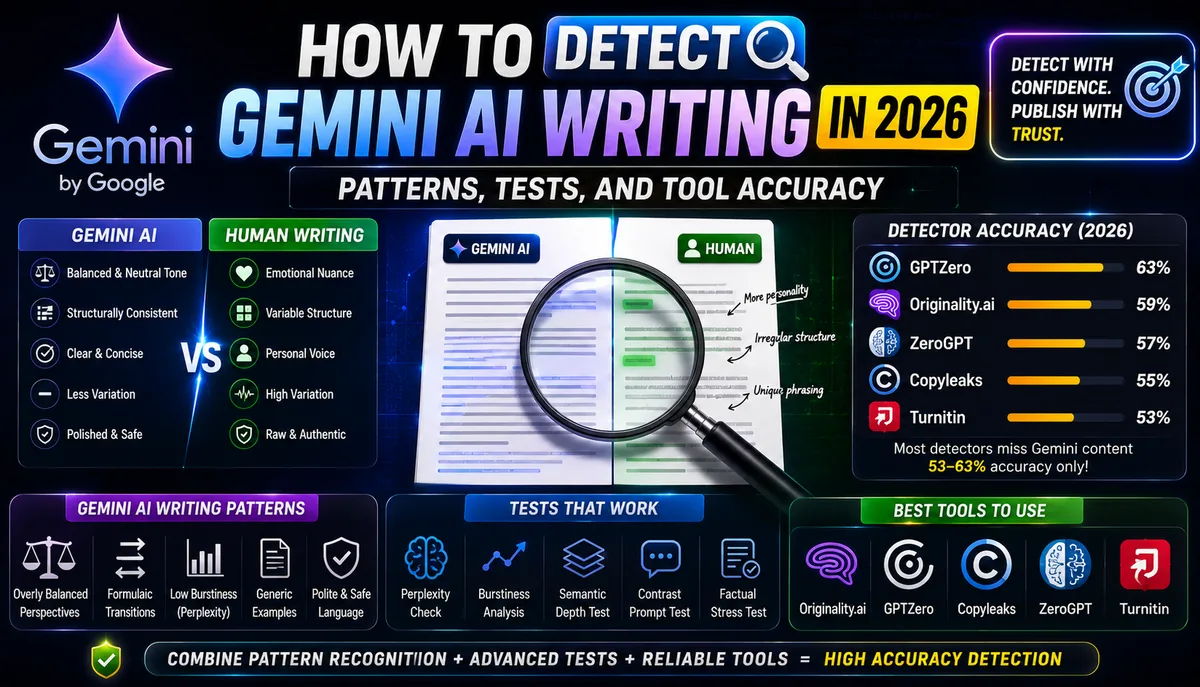
Gemini is Google's flagship large language model and one of the most widely used AI writing tools in 2026, woven directly into Google Workspace, Gmail, and Google Docs. It's also one of the least reliably detected AI models on the market.
Most AI detectors are noticeably weaker on Gemini than on ChatGPT. The gap is structural: Gemini's training data, RLHF approach, and output distributions differ from the GPT-era fingerprints most detectors were built around, so tools calibrated on GPT patterns routinely wave Gemini text through.
This guide breaks down Gemini's distinct writing signatures and how to catch them.
Why Gemini Is Harder to Detect Than ChatGPT
Training on a Different Corpus
Gemini was trained on a dataset that includes Google's extensive web index, Google Books, and structured knowledge from Google's Knowledge Graph. That produces a different reference distribution than ChatGPT, which draws more heavily on Common Crawl web text.
Gemini's outputs reflect its training in subtle ways: it tends toward more formally structured, encyclopedic writing, with precise vocabulary and measured claims — patterns more typical of professional documentation than casual web text.
Formal Register as Default
Gemini defaults to a formal, professional register even on casual prompts. It doesn't adopt the enthusiastic, motivational tone that makes ChatGPT easy to spot in consumer writing contexts. That formality fits its integration into professional tools (Gmail, Workspace, Docs) — but it also makes Gemini harder to distinguish from genuine professional human writing.
Lower Phrase-Signature Density
Gemini uses fewer of the signature phrases that make ChatGPT identifiable ("delve into," "in today's world," "navigate the complexities"). It has its own phrase tendencies, but they're less extreme — lower frequency, less consistency.
What to Realistically Expect From Detectors on Gemini
Here's what to realistically expect from the major detectors on Gemini content.
| Detector | Gemini Coverage | Notes |
|---|---|---|
| QuillBotAI Pro | Gemini-specific calibration | Per-sentence confidence output |
| Originality.ai | Partial calibration | Publishes its own coverage claims |
| GPTZero | GPT-primary calibration | Struggles with Gemini by design history |
| Scribbr | General calibration | Moderate on non-GPT models |
| ZeroGPT | No documented Gemini coverage | Expect frequent misses |
No detector performs at high confidence on Gemini — including ours. That reflects a genuinely harder detection problem, not a tool failure: Gemini's output sits statistically closer to high-quality human professional writing than ChatGPT's does. We deliberately don't publish accuracy percentages here, because no independent benchmark isolates Gemini detection across these tools, and vendor-run numbers aren't trustworthy evidence on their own.
Gemini's Identifiable Writing Patterns
Despite the detection challenges, Gemini has distinctive patterns that work as manual detection signals.
1. Encyclopedic Opening Structure
Gemini frequently opens paragraphs with definitional or contextual framing that reads like a Wikipedia lede. Where ChatGPT opens with a hook or a question, and Claude opens by reframing the question, Gemini opens by establishing context:
- "[Topic] refers to the [category] in which [definition]. First introduced in [context], it has since..."
- "As a [type of thing], [topic] primarily functions to [core purpose]."
- "[Topic] encompasses [set of things]. The key distinction from [related concept] is..."
If the writing reads like it was sourced from a structured knowledge base, Gemini is more likely than the alternatives.
2. Precise Taxonomic Language
Gemini's Knowledge Graph training shows in its tendency toward precise taxonomic classification language. It distinguishes between "types" and "categories," uses hyponyms (specific sub-types) precisely, and rarely conflates related concepts.
Compare:
- ChatGPT: "Machine learning is a type of AI that helps computers learn from data"
- Gemini: "Machine learning is a subset of artificial intelligence encompassing supervised, unsupervised, and reinforcement learning paradigms"
Gemini's precision runs higher, which makes it sound more credible — but also more rigidly taxonomic than how most humans naturally write about complex topics.
3. Parallel Construction in Lists
Gemini produces syntactically parallel list items with unusual consistency. Every bullet point in a Gemini-generated list tends to follow the same grammatical pattern:
- All verb phrases: "Improving X," "Reducing Y," "Establishing Z"
- All noun phrases at the same abstraction level
- Consistent word count across items (±2 words)
Human-written lists are messier. Some items run longer, some are fragments, some break grammatical parallelism when the thought demands it. Gemini's lists are too clean.
4. Moderate Burstiness — The Middle Zone
Claude's sentence-length variance runs noticeably higher than ChatGPT's, and both sit measurably apart from human writing's natural variance. Gemini tends to land between Claude and ChatGPT — more varied than ChatGPT's tight clustering, but still more uniform than Claude or genuine human writing.
That "middle zone" is part of why Gemini detection is harder. It's not as obviously uniform as ChatGPT, but it's not as varied as human writing either. Detectors that separate well at the extremes struggle right in the middle.
5. Qualified Claims Without Personal Investment
Gemini qualifies claims carefully, but without the philosophical investment Claude brings. Where Claude hedges because it's genuinely uncertain, Gemini qualifies because it's been trained to avoid overstatement.
The tell: Gemini's qualifications feel procedural rather than thoughtful. "This may vary depending on context" shows up at the end of claims without the writer ever explaining which contexts create that variance, or why it matters.
The Taxonomy Test: Practical Manual Detection
If you suspect Gemini authorship, apply the taxonomy test to any definitional or categorical claim in the text:
Ask: Is this claim using precise taxonomic language that would require either domain expertise or a structured knowledge source?
Gemini's access to Google's Knowledge Graph means it produces precise categorical statements a non-expert human wouldn't naturally generate without research. If the text contains accurate, well-structured taxonomic claims but the author profile doesn't suggest deep domain expertise, Gemini is a plausible source.
Detection Approach: QuillBotAI Pro + Manual Check
Because Gemini detection rates run lower across every tool, we recommend a combined approach:
Step 1: Scan with a Gemini-calibrated detector such as our Gemini detector. Since every tool scores Gemini lower than ChatGPT, even a moderate AI-confidence score on suspected Gemini content is meaningful evidence — read the per-sentence flags, not just the top-line number.
Step 2: Manually apply the taxonomy test. Does the text use precisely structured definitional language?
Step 3: Check the list structure. Are list items syntactically identical in structure and length?
Step 4: Evaluate the qualification pattern. Are claims qualified procedurally rather than thoughtfully?
Convergence across Step 1 (an elevated detection score) and two or more manual signals adds up to meaningful evidence of Gemini authorship.
Important: Gemini in Google Workspace
A specific detection challenge in 2026: Gemini is integrated directly into Gmail, Google Docs, and Google Workspace tools. Users who "polish" their drafts with Gemini's inline suggestions, or use "Help me write" to generate sections, may not think of themselves as using AI at all — they're just using a tool built into their word processor.
The practical implication: the line between "human-written with AI assistance" and "AI-written with human editing" has blurred significantly. Read detection results with that context in mind, especially in professional and workplace settings where Gemini Workspace integration is widespread.
For the other major models, see our guides on detecting ChatGPT text and detecting Claude AI writing, or the broader overview of how AI detection works.
FAQ
Why is Gemini AI harder to detect than ChatGPT? Gemini's training on structured Google knowledge sources produces more formally precise, encyclopedic writing that sits closer to high-quality professional human writing in statistical space. It has higher sentence-length variance than ChatGPT and fewer identifiable phrase signatures, which makes GPT-calibrated detectors less effective against it.
What percentage accuracy do AI detectors achieve on Gemini writing? Expect meaningfully weaker detection on Gemini than on ChatGPT from every tool. GPT-calibrated detectors routinely miss Gemini output entirely, and even Gemini-aware tools produce more ambiguous verdicts on it than on ChatGPT text.
What are the most reliable signs that text was written by Gemini? Encyclopedic definitional openings, precise taxonomic language pulled from Google's Knowledge Graph, syntactically parallel list items with consistent length, qualified claims that feel procedural rather than thoughtful, and a formal professional register that doesn't shift with emotional content.
Which AI detector is best for detecting Gemini writing? QuillBotAI Pro maintains Gemini-specific calibration rather than evaluating all AI against a single GPT baseline, and shows per-sentence confidence so ambiguous Gemini text reads as ambiguous instead of falsely certain. No tool detects Gemini as reliably as ChatGPT — treat any claim otherwise with skepticism.
Does Gemini's integration into Google Docs affect detection? Yes. Gemini's inline suggestions and "Help me write" feature in Google Workspace create hybrid documents where Gemini contributions blend with human writing. Those are harder to detect than pure Gemini output, and accuracy degrades further when Gemini is used to enhance existing text rather than generate it from scratch.
Topics
Written & Reviewed By Experts
Zoe Parker
AuthorFounder & Lead AI Research Scientist, QuillBotAI Pro
NLP Specialization · DeepLearning.AI via Coursera (2024–2025)
Zoe is the founder of QuillBotAI Pro and leads its detection research. Her work focuses on computational linguistics and identifying how large language models produce text.
Editorial policy: All QuillBotAI Pro articles are written by domain experts, independently peer-reviewed, and updated as new research emerges. We never accept sponsored content that influences editorial conclusions.