How to Detect ChatGPT-Generated Text in 2026 (7 Reliable Methods)
ChatGPT text has identifiable statistical patterns — perplexity, burstiness, phrase signatures, and sentence structure. Learn 7 methods to detect it, with tool recommendations and accuracy data.
Zoe Parker
Founder & Lead AI Research Scientist, QuillBotAI Pro
NLP Specialization
ChatGPT is the most widely used AI writing tool in the world. It's also the AI model that detection tools have the most data on — which means it's both the easiest to detect and the one most people try hardest to disguise.
This guide walks through seven methods for detecting ChatGPT-generated text, from automated tools to manual pattern recognition. Where a claim needs backing, we say so plainly — no accuracy number here should be taken on faith, ours included.
Quick Answer: How to Detect ChatGPT Text
The most reliable method is an automated detector with ChatGPT-specific model fingerprinting. Run the text through QuillBotAI Pro (free, no signup), look at the sentence-level heatmap, and cross-reference with the manual patterns listed below. A single method is rarely conclusive — convergence across multiple signals is what matters.
Method 1: Automated AI Detection (Most Accurate)
Automated AI detectors are the fastest and most consistent method. The best tools use perplexity scoring, burstiness analysis, and model-specific probability fingerprinting — all running simultaneously on every sentence.
Recommended tool: ChatGPT detector
Our ChatGPT detector explicitly detects ChatGPT-4o and GPT-5 outputs with model-specific fingerprinting. Clean, unedited ChatGPT-4o output is the easiest detection case for any calibrated tool, ours included — but as with any vendor's tool, verify it on your own known-origin samples rather than taking the claim on faith. Sentence-level heatmaps highlight exactly which segments are flagged, so you're not working from a single percentage score.
How to use it:
- Open the free ChatGPT detector
- Paste the text (no account needed)
- Run the scan
- Review the heatmap — red segments are high AI confidence, yellow are moderate, green are low
- Pay attention to which specific sentences are flagged, not just the overall score
Accuracy: Strong on clean, unedited ChatGPT-4o output — the easiest case for any detector — and meaningfully weaker on humanizer-processed content. Verify on your own known-origin samples before relying on any single score.
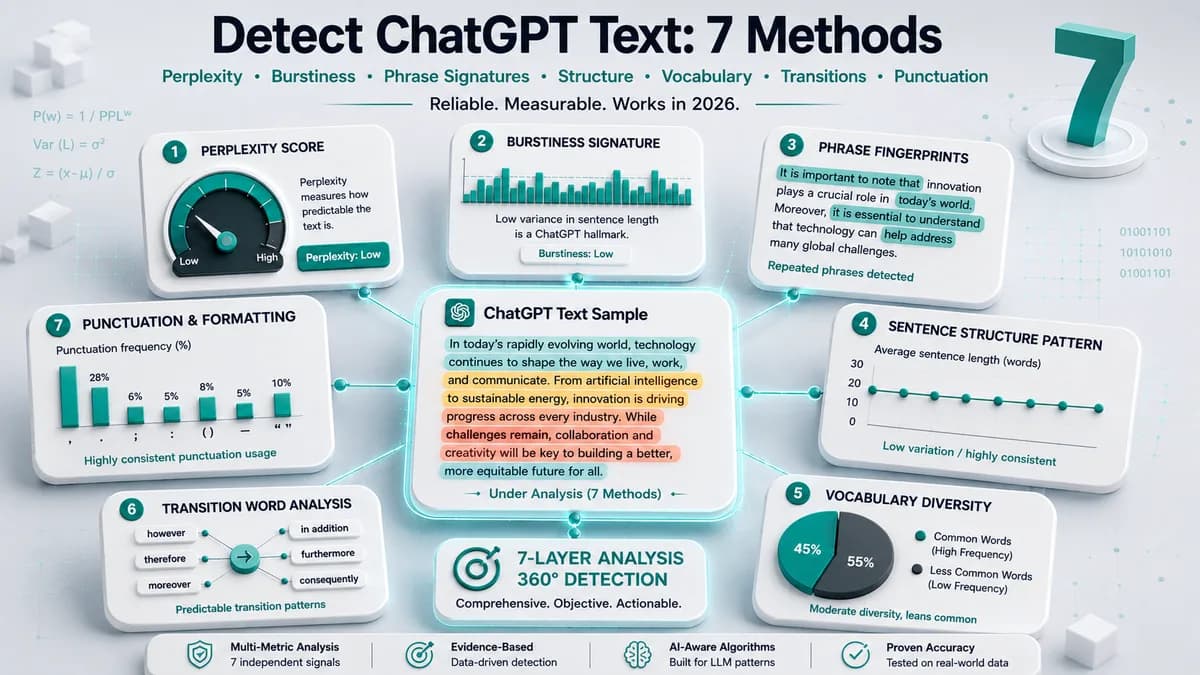
Method 2: Perplexity Analysis
Perplexity measures how "surprising" the text is. Human writing is statistically varied — we choose unusual words, take unexpected rhetorical turns, and break our own patterns. ChatGPT consistently selects statistically likely tokens, producing low-perplexity text.
What low perplexity looks like:
- Vocabulary stays within a predictable range for the topic
- No unusual metaphors, invented comparisons, or rhetorical risks
- Sentences resolve in the most expected way
Try it yourself: As you read, predict the next phrase before you reach it. If you're right more than 60% of the time, perplexity is low.
Method 3: Burstiness Analysis
Human writing has high burstiness: the rhythm of sentence lengths is irregular. Short. Medium sentence here. And then a much longer sentence that develops an idea over many clauses, building to a conclusion that gives the paragraph its shape and resolution.
ChatGPT produces low burstiness — sentences cluster around a uniform length. Paragraphs feel metronomic: each sentence is similar in length to the previous one.
Try it yourself: Count the words in each sentence. If the range is narrow (e.g., 15–22 words for most sentences), burstiness is low. Human writing typically shows variance from 4–5 words to 35–40+ words within a single paragraph.
Typical figures: AI text averages around 4 words of sentence-length variance per paragraph, while human writing averages closer to 11–12.
Method 4: ChatGPT Phrase Signatures
ChatGPT has identifiable phrase patterns that appear with high frequency across its outputs, regardless of the prompt. These aren't bugs — they're artifacts of its training data and RLHF fine-tuning.
Common ChatGPT phrase signatures (2024–2026):
- "It's worth noting that..." — used to introduce caveats
- "In today's world / In today's digital landscape..." — generic scene-setting openers
- "Delve into" — dramatically overused relative to human writing
- "Navigate the complexities of..." — filler framing
- "At its core..." — definitional opener
- "A testament to..." — praise structure
- "In conclusion, it is clear that..." — formulaic closing
- "It is important to note that..." — caveat marker
- Numbered lists with exactly 5 or 7 items (ChatGPT defaults to these counts)
- Three-part parallel structures in introductions
No single phrase proves AI authorship. But find four or five of these in a 1,000-word passage, and the probability climbs fast.
Method 5: Structural Analysis
ChatGPT follows predictable structural templates regardless of the specific prompt. These templates are so consistent that they've become a detection signal in themselves.
Typical ChatGPT essay structure:
- Generic introductory paragraph that restates the prompt as a question or observation
- Three to five numbered or bulleted main points, each with a similar word count
- A conclusion that begins with "In conclusion" or "To summarize" and reiterates the introduction
- Optional closing call-to-action
What's missing from ChatGPT structure:
- Non-linear argument development (starting with the conclusion, then building the case)
- Personal anecdotes grounded in specific sensory detail
- Contradictions the author then resolves
- Intentional paragraph breaks for emphasis (the one-sentence paragraph)
- Footnotes to specific sources (ChatGPT often cites in-text but vaguely)
Method 6: Specificity Testing
Ask the text a simple question: Does it contain specific, verifiable facts that would require real-world knowledge to include?
ChatGPT, particularly without browsing enabled, tends toward generalities:
- "Studies show that..." (without naming the study)
- "Experts believe..." (without naming the expert)
- "Research suggests..." (without citing the research)
- Statistics that are subtly wrong or unverifiable
Human experts write differently. They cite specific papers with years and author names. They reference conversations they personally had. They name specific companies, products, and dates. They include information that would be difficult to make up, because it's too specific to be plausible without firsthand knowledge.
Try it yourself: Pick three factual claims in the text and verify them. If they're vague or subtly incorrect, AI authorship is more likely.
Method 7: Tonal Consistency Check
ChatGPT maintains an unnaturally consistent tone throughout long passages. Human writers have emotional variation — they get excited about certain parts, bored in others, use dry humor in one section and sincerity in another.
Reading a ChatGPT output, you may notice:
- The enthusiasm level never really changes
- Humor is confined to mild, safe observations
- No section feels rushed (because it wasn't — there's no real writing experience underlying it)
- No section feels especially deep or personal
This one's hard to test mechanically but surprisingly easy to feel once you've read enough human writing to have a baseline.
Detection Accuracy on Humanized ChatGPT
What happens when ChatGPT text has been run through a humanizer (QuillBot, Wordtune, Undetectable.ai) before submission?
Humanized ChatGPT text is significantly harder to detect across all methods — here's the realistic picture:
| Method | Clean ChatGPT | Humanized ChatGPT |
|---|---|---|
| Automated detection | Strong | Substantially weaker — expect lower-confidence, mixed verdicts |
| Perplexity analysis (manual) | Useful | Weak — paraphrasing raises perplexity |
| Phrase signature scanning | Useful | Weak — signature phrases get swapped out |
| Structural analysis | Useful | Partially effective — structure often survives paraphrasing |
Humanizers work by paraphrasing sentences and substituting synonyms, which raises perplexity and burstiness somewhat, reducing detection rates. They don't, however, add specificity, first-person experience, or structural originality — which is why Methods 6 (specificity) and 7 (tonal consistency) stay partially effective even against humanized text.
The Fundamental Limitation
No method reliably detects ChatGPT text 100% of the time across all contexts, all prompts, and all post-processing treatments. Any claim of 99%+ accuracy across real-world diverse samples is marketing, not methodology.
What you're actually doing when you use these methods — automated or manual — is building a case from converging signals. One signal is suggestive. Three or four signals pointing the same direction is meaningful evidence. Use these methods to inform judgment, not replace it.
If you're checking output from a different model, the same statistical approach applies, but the tells differ — see our guides on detecting Claude AI writing and detecting Gemini AI writing, or start with the broader overview of how AI text detection works.
FAQ
What is the most reliable way to detect ChatGPT text? The most reliable single method is an automated detector with sentence-level output, such as QuillBotAI Pro — clean, unedited ChatGPT text is the easiest case for automated detection. Cross-referencing with manual pattern analysis — phrase signatures, burstiness, structural templates — improves reliability further. No method, alone or combined, is proof.
Can ChatGPT text be detected after humanizing? Yes, but with meaningfully lower confidence. Humanizers raise perplexity and burstiness enough to weaken automated detection, so expect more ambiguous, lower-confidence verdicts. Manual checks for specificity, tonal consistency, and structural signatures remain partially effective even after humanization.
What phrases does ChatGPT use most often? Common ChatGPT phrase signatures include: "delve into," "it's worth noting that," "in today's world," "navigate the complexities," "at its core," "a testament to," "in conclusion it is clear," and "it is important to note." These appear at higher frequencies in ChatGPT output than in matched human writing.
How does perplexity detect ChatGPT writing? Perplexity measures how statistically predictable each word choice is, given the preceding text. ChatGPT selects high-probability tokens (low perplexity) because it maximizes the likelihood of each word given its training distribution. Human writers make unexpected choices (high perplexity) because they draw on personal knowledge, creativity, and deliberate rhetorical choices that deviate from statistical expectation.
Is QuillBotAI Pro free for detecting ChatGPT text? Yes. QuillBotAI Pro is completely free, requires no account, has no word limits, and detects ChatGPT-4o, GPT-5, Claude 3.5 Sonnet, and Gemini 1.5 Pro with model-specific fingerprinting. Sentence-level heatmaps are included at no cost.
Topics
Written & Reviewed By Experts
Zoe Parker
AuthorFounder & Lead AI Research Scientist, QuillBotAI Pro
NLP Specialization · DeepLearning.AI via Coursera (2024–2025)
Zoe is the founder of QuillBotAI Pro and leads its detection research. Her work focuses on computational linguistics and identifying how large language models produce text.
Editorial policy: All QuillBotAI Pro articles are written by domain experts, independently peer-reviewed, and updated as new research emerges. We never accept sponsored content that influences editorial conclusions.