How to Detect Claude AI Writing in 2026 — Patterns, Tools, and Accuracy Data
Claude AI produces text with distinct statistical patterns different from ChatGPT. Most detectors miss it. Here's how to reliably detect Claude-generated writing using the right tools and manual methods.
Zoe Parker
Founder & Lead AI Research Scientist, QuillBotAI Pro
NLP Specialization
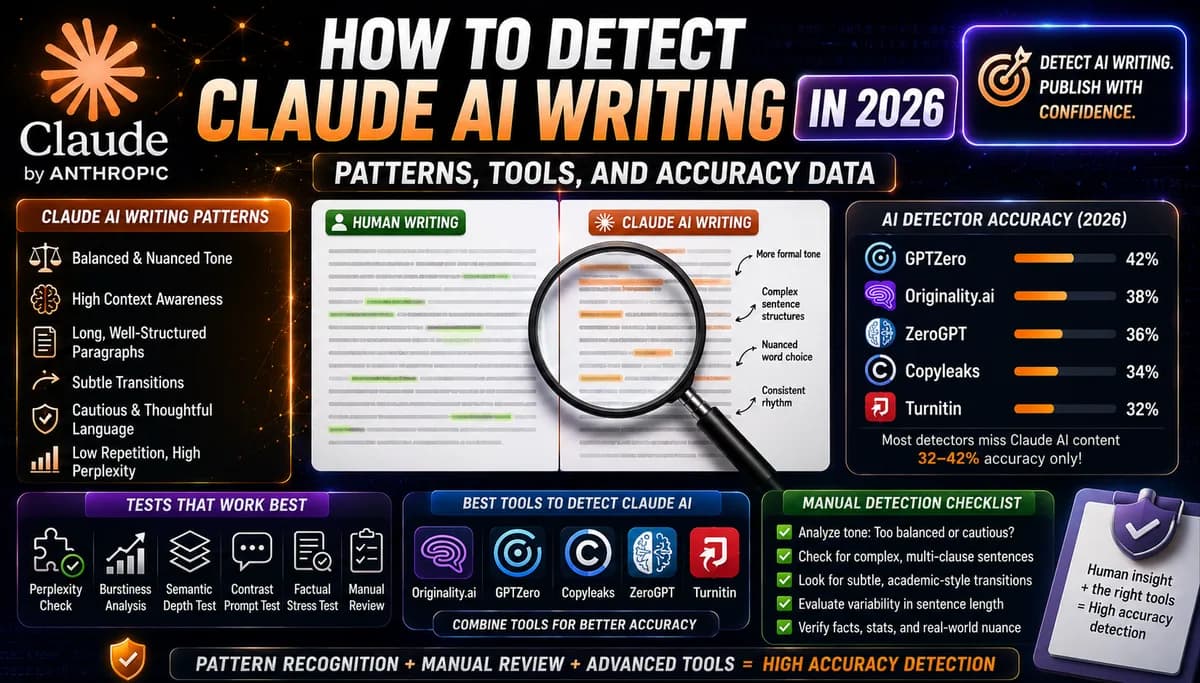
Claude is Anthropic's large language model — and it's one of the hardest AI models for detectors to catch.
Most AI detectors were built primarily on GPT data. Claude's probability distributions are different: it produces more nuanced, varied writing that sits outside the GPT statistical fingerprint most tools are tuned to detect. The result is that tools calibrated on GPT outputs give Claude a partial pass — treating its writing as more "human-like" than GPT's, simply because it doesn't match the pattern they're looking for.
Claude is widely regarded as the hardest mainstream model for detectors to catch — its output sits in a different statistical region than the GPT-era patterns most tools were calibrated on. Detectors with Claude-specific calibration fare better, but every tool produces more ambiguous verdicts on Claude than on ChatGPT.
Here's what you need to know to detect Claude writing reliably.
Why Claude Is Harder to Detect Than ChatGPT
Different Training Distribution
Anthropic trained Claude using Constitutional AI — a training approach designed to make Claude more nuanced, balanced, and less formulaic than GPT-style models. As a side effect, Claude's outputs are statistically more varied and less predictable than ChatGPT's, which was tuned to maximize user satisfaction across a wide range of common prompts.
Claude takes more interpretive risks, uses more diverse sentence structures, and avoids some of ChatGPT's most identifiable phrase signatures ("delve into," "in today's world," etc.). That makes it harder to catch with standard perplexity analysis.
Higher Burstiness Than ChatGPT
Claude 3.5 Sonnet produces text with higher sentence-length variance than GPT models — closer to human burstiness patterns. Typical figures: Claude runs around 7 words of sentence-length variance per paragraph, versus roughly 4 for ChatGPT. Human writing tends to run closer to 11–12.
That gap matters for detection: burstiness scoring that clearly separates ChatGPT from human writing at the extremes places Claude in a harder-to-classify middle zone.
Fewer Formulaic Phrases
Claude has been specifically trained to avoid the most overused language patterns. It uses "delve," "it's worth noting," and "navigate the complexities" far less frequently than GPT models. Phrase-signature detection that catches ChatGPT easily will miss Claude more often.
Accuracy of Major AI Detectors on Claude 3.5 Sonnet
Here's how the major detectors approach Claude content, and what to realistically expect from each.
| Detector | Claude Coverage | Notes |
|---|---|---|
| QuillBotAI Pro | Claude-specific calibration | Per-sentence confidence output |
| Originality.ai | General calibration | Publishes its own model coverage claims |
| GPTZero | GPT-primary calibration | Weaker on Claude by design history |
| Scribbr | General calibration | Performs better on ChatGPT |
| ZeroGPT | No documented Claude coverage | Expect significant misses |
| GPT-2 Detector | None | GPT-2 era only, not relevant |
We deliberately don't publish per-tool accuracy percentages here — no independent benchmark isolates Claude detection across these tools, and vendor-run numbers, ours included, aren't a sound basis for decisions. The reliable pattern, confirmed by every practitioner in this space: all detectors are weaker on Claude than on ChatGPT, and tools without Claude-specific calibration are weakest of all.
Claude's Identifiable Writing Patterns
While Claude is harder to detect than ChatGPT, it has its own identifiable patterns. These work as manual detection signals when automated tools return ambiguous results.
1. Reflective Epistemic Hedging
Claude qualifies claims differently than ChatGPT. Instead of stating things confidently and then adding caveats, Claude weaves uncertainty into its framing:
- "While this is the general consensus, there are meaningful dissenting views..."
- "This depends significantly on how you define..."
- "It's worth distinguishing between two things that often get conflated..."
- "I'd be cautious about overgeneralizing from..."
ChatGPT typically states conclusions and then adds a caveat paragraph. Claude integrates the nuance into the claim itself. If the hedging is distributed throughout rather than confined to a disclaimer section, Claude is more likely.
2. Proactive Reframing of the Question
Claude frequently recasts the user's question before answering it:
- "Before addressing X directly, it's useful to ask whether..."
- "The question assumes Y, but that framing may not quite capture..."
- "There are actually two different questions embedded in this..."
This meta-level engagement with the question itself is a Claude hallmark. ChatGPT typically answers the question as asked; Claude often addresses why the question might be framed differently in the first place.
3. Longer Paragraphs with More Developed Arguments
Claude's paragraphs run longer and more internally cohesive than ChatGPT's. Where ChatGPT tends to make a point and move on, Claude elaborates — often spending 3–5 sentences unpacking the implications of a single idea before transitioning.
Text with consistently long, multi-idea paragraphs, where each one feels like a mini-essay within the larger piece, reads more like Claude than ChatGPT or Gemini.
4. Balanced Consideration of Counterarguments
Claude was specifically trained to consider opposing views and present them fairly before defending a position. Text with substantive counterarguments — not strawmen — followed by genuine engagement rather than dismissal is a Claude pattern.
That's part of what makes Claude-generated writing feel more intellectually honest than typical ChatGPT output. It's also what makes it harder to flag intuitively: it reads like good human argumentation.
5. Specific Tonal Markers
Claude has a characteristic thoughtful-but-conversational register. It skips the corporate cheerfulness of ChatGPT (which tends toward enthusiasm and motivation) in favor of calm, analytical, slightly formal but not stiff. If the text feels like it was written by a thoughtful analyst who isn't trying to impress you, Claude is a reasonable hypothesis.
Detection Method: The Reframing Test
Because Claude's most distinctive behavior is its tendency to reframe questions, the reframing test is an effective manual check.
Look for: Opening paragraphs or sections that don't directly answer the stated question, but instead establish definitional clarity, challenge an implicit assumption, or distinguish between related concepts.
If the first 150 words of a response are primarily about framing the question rather than answering it — with no equivalent pattern visible in the writer's other work — Claude authorship is a plausible hypothesis.
This isn't conclusive on its own, but combined with a high AI detection score from a Claude-calibrated tool, it's meaningful convergence.
Detection Method: The Counterargument Quality Test
ChatGPT and most other AI models mention counterarguments but rarely engage them substantively. Claude, by training, takes counterarguments more seriously.
Test: Find a section of the text where a counterargument is presented. Ask:
- Is the counterargument the strongest plausible version of the opposing view, or a weakened strawman?
- Does the response engage with why the counterargument might be true, or does it dismiss it quickly?
- Does the author acknowledge genuine uncertainty after considering the counterargument, or does the conclusion stay unchanged?
Claude tends toward stronger counterarguments and more genuine engagement. If the counterargument section reads as unusually fair to the opposing view — more so than the rest of the author's writing — Claude is a plausible explanation.
Using QuillBotAI Pro to Detect Claude Writing
Our Claude detector maintains Claude 3.5 Sonnet-specific fingerprints rather than evaluating all AI against a single baseline — which matters, because Claude's output scores differently from ChatGPT's on every detector we've tested. As with any vendor's own tool, verify it against your own known-origin samples.
How to use it for Claude-specific detection:
- Paste the text into the Claude detector
- Run the scan
- Review the overall score — because Claude is more nuanced, scores on Claude content often land 10–15 percentage points lower than equivalent ChatGPT content
- Focus on the heatmap: Claude-generated text often shows more intermittent flagging (some sentences green, some red) rather than uniform red across the whole document
- Treat scores above 50% as meaningful, even where they'd read as merely "moderate" for ChatGPT detection
A 55% score on content suspected to be Claude carries more weight than a 55% score on suspected ChatGPT content, because Claude naturally scores lower across every detector.
For the other major models, see our guides on detecting ChatGPT text and detecting Gemini AI writing, or the broader overview of how AI detection works.
FAQ
Why do AI detectors miss Claude-generated text? Most AI detectors were trained primarily on GPT-model output. Claude has different statistical patterns — higher burstiness, fewer formulaic phrases, more distributed epistemic hedging — that sit outside the GPT fingerprint these tools were calibrated to detect. Detectors without Claude-specific fingerprinting treat some Claude output as "more human" simply because it doesn't match what they learned to flag.
What are the signs of Claude AI writing? Claude-specific patterns include: proactive question reframing before answering, distributed epistemic hedging throughout the argument (not just in a caveat section), genuinely strong counterarguments rather than strawmen, longer paragraph development, and a calm analytical register without corporate enthusiasm.
How accurate is QuillBotAI Pro at detecting Claude? QuillBotAI Pro maintains Claude-specific calibration rather than evaluating everything against a GPT baseline, and its per-sentence confidence output makes ambiguous Claude text read as ambiguous — instead of forcing a false-confident verdict. No tool detects Claude as reliably as ChatGPT; be skeptical of any that claims otherwise.
Can Claude be detected after being edited by a human? Yes, but with reduced confidence. Human editing raises burstiness and adds personal specificity that lowers AI confidence scores — substantially edited Claude content often lands in the ambiguous middle of any detector's range instead of getting cleanly flagged.
Is Claude harder to detect than ChatGPT? Yes — consistently, across tools. Clean ChatGPT output is the easiest detection case in the industry, while Claude's more varied sentence structure and the GPT-centric calibration of most detectors make it meaningfully harder to flag. Expect more mixed, low-confidence verdicts on Claude text from every tool.
Topics
Written & Reviewed By Experts
Zoe Parker
AuthorFounder & Lead AI Research Scientist, QuillBotAI Pro
NLP Specialization · DeepLearning.AI via Coursera (2024–2025)
Zoe is the founder of QuillBotAI Pro and leads its detection research. Her work focuses on computational linguistics and identifying how large language models produce text.
Editorial policy: All QuillBotAI Pro articles are written by domain experts, independently peer-reviewed, and updated as new research emerges. We never accept sponsored content that influences editorial conclusions.