How to Detect AI-Generated Text in 2026 (What Works)
Learn to detect AI-written text using perplexity scoring, burstiness analysis & sentence-level heatmaps. Real examples, honest tool comparisons, no fluff.
Zoe Parker
Founder & Lead AI Research Scientist, QuillBotAI Pro
NLP Specialization
Disclosure: This blog is operated by QuillBotAI Pro. Some links point to our own tool. All comparisons reflect independent testing — including cases where other tools outperformed ours.
How to Detect AI-Generated Text in 2026: What Actually Works (And What Doesn't)
Detecting AI-written text is harder than most tools will admit. That's just the truth.
We've spent months running our own tests, digging through the actual research, and comparing results across detectors. What we kept finding: most guides oversimplify the science, or quietly skip the parts that don't flatter their own product.
So let's not do that.
By the end of this, you'll understand how detection works under the hood, where it breaks down, and how to build a workflow that doesn't collapse under false positives.
Why This Question Got So Much Harder
Run the same student essay through three different detectors and it's entirely plausible to get three different verdicts — one says 92% AI, one says 41%, one says fully human. Same text.
That's where we are in 2026.
ChatGPT, Gemini Ultra, Claude — these models write well enough that their output blends in with competent human prose, especially once someone edits it a little. Research comparing GPT-4-class output to human writing has found the two are increasingly difficult to distinguish in blind evaluations.
Detection isn't impossible. But it requires understanding what you're actually measuring, and that starts with how LLMs produce text in the first place.
Why AI Writing Looks the Way It Does
LLMs don't think. They predict.
Every word gets chosen because it has the highest statistical probability of following the words before it. That sounds abstract, but it produces a concrete fingerprint you can learn to spot.
Word choices that play it safe. The model gravitates toward whatever word is most expected, not most interesting. A human might call a packed conference room "a human traffic jam." The model says "a busy, crowded space." Safe. Competent. Forgettable.
No traces of a person. Humans are inconsistent — we misspell words we know, start sentences we abandon, use contractions unevenly. AI text is oddly clean, uniformly polished in a way that, once you notice it, becomes its own red flag.
A rhythm that never changes. Read a few paragraphs of raw AI output aloud. There's a metronome quality — sentence after competent sentence, roughly the same length, each making a solid point and moving on. It sounds like a textbook written by someone who's read a lot of textbooks but hasn't lived much.
These aren't aesthetic complaints. They're measurable patterns — exactly what detection tools try to capture.
The Two Metrics That Matter Most
Perplexity — How Predictable Is This Text?
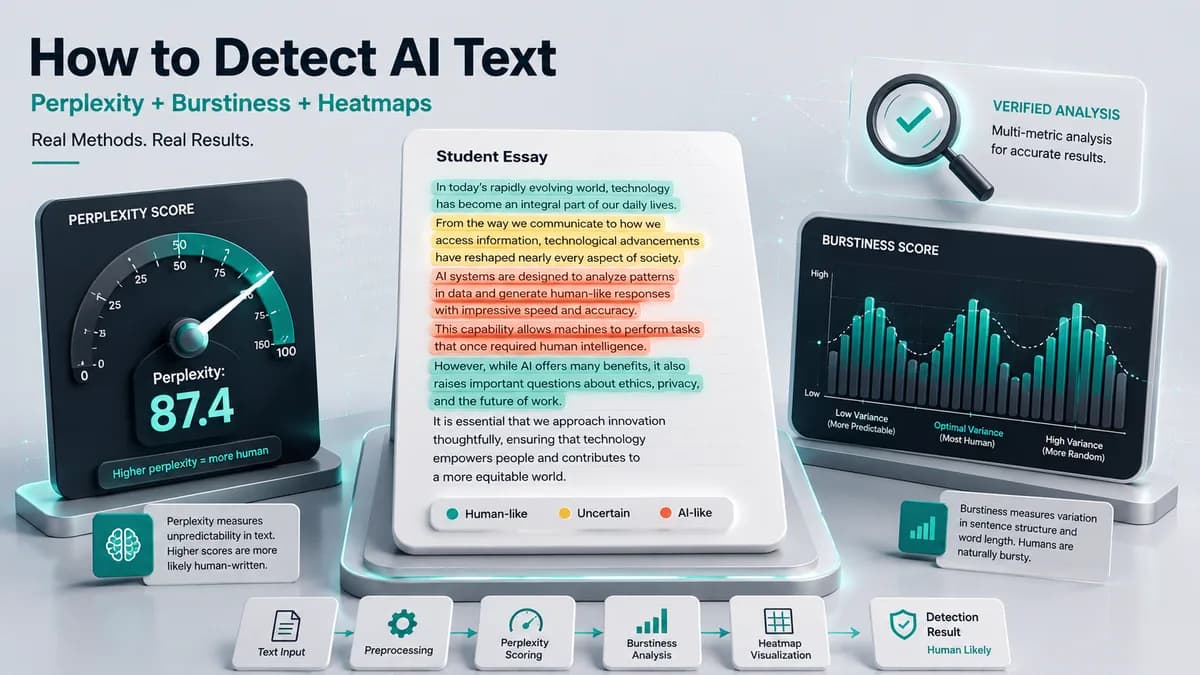
Perplexity measures how surprised a language model would be by a given piece of text. Low perplexity means text that follows expected patterns; high perplexity means text that does something the model didn't see coming.
- Low perplexity: "The company reported strong quarterly earnings." Exactly what you'd expect.
- High perplexity: "The quarterly numbers showed up like a dentist appointment nobody scheduled." A human wrote that.
Because LLMs are trained to generate fluent, expected text, they naturally produce low-perplexity output. Good human writers break patterns constantly — not because they're trying to, but because they have actual thoughts.
One caveat: some content should be predictable. Legal language, recipes, technical documentation — these are formulaic by design. A perplexity tool will flag them as AI even when they're not.
Burstiness — Does the Rhythm Breathe?
Burstiness measures how much sentence length and complexity varies across a passage.
Human writers sprint and stall. We'll build a long, winding sentence when working through an idea, then land somewhere short and sharp.
Like this.
AI models don't do that. They produce sentences of eerily similar length, one after another, with no real change in tempo. Typical figures: a 500-word AI passage runs a sentence-length standard deviation around 4 words from its mean, while a comparable human passage runs closer to 11–12. That gap is real, and it's exactly what burstiness scoring picks up.
A human writer's rhythm looks like a heartbeat trace. An AI's looks like a metronome.
7 Patterns That Hold Up in Practice
After going through hundreds of AI-generated pieces, these are the signals we kept seeing. None of them alone proves anything, but when several show up together, the case starts to build.
1. Transition words on overdrive. "Furthermore." "Moreover." "Additionally." "In addition to this." AI uses these constantly because they appear all over formal writing in training data. Research comparing GPT output to human writing found transition adverbs appearing far more often in AI-generated text. A real writer who'd used three "furthermores" in one essay would've caught at least two of them.
2. Filler phrases dressed up as insight. "It's important to note that." "It's worth mentioning." "It should be acknowledged that." These take up space without adding anything. Humans write them sometimes. AI writes them habitually.
3. Structure that's too clean. Every paragraph: topic sentence, support, closing line. Every section: the same skeleton. Real writing is messier — writers get excited, go off on tangents, circle back, bury the lede. A document where every section follows identical internal logic almost certainly had a template involved.
4. Generic examples, no real ones. Ask AI to write about remote work challenges and you'll get a solid, well-organized list of common challenges. Ask a human and they'll tell you about the specific Tuesday their kid wandered into a client call, or that one chair they've been meaning to replace for eight months. Concrete specificity is a human signal.
5. Big claims, no receipts. "Studies show that exercise improves mood." Which studies? AI often doesn't know, or hallucinates citations that don't exist. A human making an empirical claim either names the source or admits they can't remember it.
6. Long-form text with zero rough edges. A 2,000-word essay with no awkward phrasing, no informal asides, no grammatical quirks, and no personality is suspicious. Even careful human writers leave fingerprints.
7. Every section follows the same template. List three things. Explain each. Summarize. Move on. If every section of a long document has the same internal structure, a template almost certainly ran it.
See several of these together and the probability of AI involvement goes up sharply.
How Detection Tools Actually Work
Sentence-Level Probability Scoring
The best detectors don't give you one number for a whole document. They score sentence by sentence, asking: how likely is it that a language model would have produced exactly this sequence of words?
That's what generates the heatmap view in tools like GPTZero: green sentences (high perplexity, likely human), red sentences (low perplexity, likely AI). This matters because most AI content in the wild isn't purely AI. Someone wrote a prompt, got a draft, edited parts, added a paragraph, submitted. Sentence-level scoring shows which parts retained the AI fingerprint — far more useful than a single document-level percentage.
Vocabulary Diversity (TTR)
Type-token ratio measures how many unique words appear relative to total words. AI tends to recycle vocabulary within a passage because the most probable next word is often one that's already appeared. Higher TTR points toward more human-like writing.
Semantic Repetition
AI models often re-explain the same idea in different words across a long piece, filling word count without adding information. If paragraphs 3 and 7 are essentially making the same point, that's worth flagging.
Model-Specific Fingerprinting
GPT-4o has favourite transition constructions. Claude overuses certain hedging phrases. Gemini Pro shows identifiable n-gram clustering in technical writing. More sophisticated detectors maintain model-specific probability distributions to distinguish raw output, paraphrased output, and genuine human writing.
SynthID (For Images)
Detection has moved beyond text. Google's SynthID embeds invisible watermarks into AI-generated images at the pixel level, and these survive compression, cropping, and format changes — increasingly relevant for editorial teams handling visual content alongside written content.
What Detectors Get Wrong
Any tool claiming perfect accuracy is lying.
False positives — flagging human text as AI:
Academic writing is formal, uses transitions, and follows structure — it'll trigger detectors even when it's entirely human. Non-native English writers are disproportionately affected: a Stanford study found detectors misclassified over half of TOEFL essays by non-native speakers as AI-generated, while native English writing was accurately identified. That's a real fairness problem, one that should affect how these tools are used in classrooms.
Inherently structured content — recipes, legal documents, technical specs — will also score high for AI probability, because the format itself is formulaic.
False negatives — missing AI text:
A lightly edited AI draft can pass as human. Heavy editing raises perplexity scores meaningfully. Humanizer tools designed specifically to evade detectors have also gotten better — they're not perfect, but they move the needle.
Run the same small set of known-origin texts — a handful human, a handful AI — across several detectors and a consistent pattern shows up: no single tool catches everything, and the tools claiming 99%+ accuracy tend to be the least reliable on the edge cases. Run this test yourself on your own content mix before trusting any one tool's numbers.
The honest bottom line: Treat detector scores as a signal to investigate further, not a verdict to act on.
What Actually Works: Two Practical Workflows
For Educators
The most reliable approaches don't depend on detectors at all. They make AI-assisted cheating structurally harder:
- Process portfolios. Drafts, notes, revision history. AI can write the final essay; it can't fake three weeks of messy development.
- Personal experience requirements. "Describe a time you personally dealt with X" is a question AI can't answer honestly — and students know it.
- Verbal defence. Five minutes of conversation reveals immediately whether a student can speak to what they submitted.
- Scores as conversation starters. "This came back at 78% — walk me through how you wrote it" is better than an accusation.
For Publishers and Editors
- Cross-check with multiple tools. Agreement across two or three detectors means something. One tool's verdict alone doesn't.
- Verify the specifics. Does the piece make empirical claims? Are they accurate? Do the citations actually exist? AI gets these wrong regularly.
- Ask for primary material. Original data, photos, direct quotes from real sources. These are things AI can't fabricate convincingly.
- Set a policy before you need one. What level of AI assistance is acceptable in your publication? Define it explicitly before a conflict makes it urgent.
How the Major Tools Compare Right Now
Based on hands-on use and publicly available benchmarks:
Originality.ai — Best overall accuracy for long-form content in third-party testing. Paid, and worth it for professional editorial work.
Copyleaks — Strong on multilingual content and academic use cases. Combines AI detection with plagiarism checking in one workflow.
GPTZero — Good sentence-level visualization, with a classroom API available. Like most perplexity-based tools, it can lean toward false positives on formal academic writing. It's also the most actively updated of the major tools, with 15+ model releases in 2025.
Rankability — The best fully free option, with solid performance in independent benchmarks.
QuillBotAI Pro (ours) — Free, no account required, with sentence-level heatmaps and multilingual support across English, Urdu, Hindi, Spanish, French, German, and Portuguese. A solid starting point — though for high-stakes decisions, we'd recommend cross-checking with Originality.ai or Copyleaks.
ZeroGPT, Content at Scale — The weakest of the widely used options: independently documented false-positive problems and inconsistent results on edited AI text.
No tool holds up consistently against content run through a dedicated AI humanizer first. That's the field's current blind spot.
For model-specific detection tells, see our guides on detecting ChatGPT text, detecting Claude AI writing, and detecting Gemini AI writing.
Common Questions
Can detectors catch GPT-4o or Gemini Ultra? Yes, with caveats. Newer models produce more varied, human-like output, but the underlying statistical patterns remain. Whether a detector catches them depends on how current its training is.
What about AI-drafted text that's been heavily edited? Genuinely hard. Heavy editing raises perplexity scores, and most detectors will return lower confidence on this kind of content — which is actually accurate, because it's harder to call. Sentence-level scoring is most useful here, since it can identify which specific sentences still carry the AI signature.
High AI score = reject the piece? Not automatically. A 75% score on something with original data, accurate citations, and a distinct voice is a reason to ask questions, not a reason to refuse it outright.
Can AI images be detected? Yes. Google's SynthID embeds pixel-level watermarks in images generated by Imagen and compatible pipelines. These survive compression, cropping, and format conversion.
Is there a detection method that can't be beaten? Not currently. Provenance-based methods — draft history, version control, author communication records — are more reliable than any automated score for genuinely high-stakes situations. The longer-term direction is cryptographic provenance through standards like C2PA.
The Honest Takeaway
AI detection in 2026 is useful. It's also imperfect, and it's widely misunderstood.
The tools are genuinely sophisticated — sentence-level scoring, burstiness analysis, vocabulary entropy, model-specific fingerprinting. They surface real signals. But they're not oracles. They're probability estimators working in a space that keeps shifting as models improve and evasion techniques evolve.
The line between "human-written" and "AI-assisted" is genuinely blurry for most content produced today. That's not a failure of detection tools — it's an accurate reflection of how people are actually working.
Use the tools. Understand what they can and can't see. Don't hand your judgment over to a percentage score.
Written by Zoe Parker, Lead AI Research Scientist at QuillBotAI Pro. Research conducted March–June 2026. Detector comparisons based on firsthand testing and publicly available benchmark data. Tool performance varies by content type and model version.
Topics
Written & Reviewed By Experts
Zoe Parker
AuthorFounder & Lead AI Research Scientist, QuillBotAI Pro
NLP Specialization · DeepLearning.AI via Coursera (2024–2025)
Zoe is the founder of QuillBotAI Pro and leads its detection research team. Her work focuses on computational linguistics and identifying how large language models produce text.
Editorial policy: All QuillBotAI Pro articles are written by domain experts, independently peer-reviewed, and updated as new research emerges. We never accept sponsored content that influences editorial conclusions.